

Safety for production cells and industrial robots
Safety is the top priority when it comes to automated production environments. Performing a systematic risk assessment, defining protected zones, using safety locking devices and implementing reliable emergency stop functions ensure that humans and machines can work together safely. Modern stationary robot systems also feature advanced motion control, collision avoidance, adaptive gripping technology and, increasingly, functions for direct collaboration with humans.
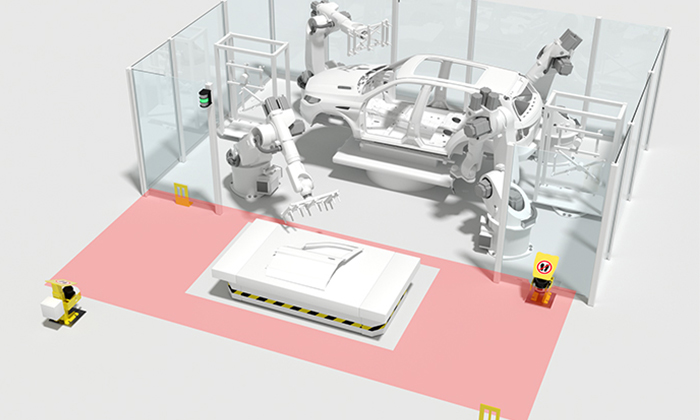
For repetitive workflows as well as for heavy or potentially hazardous process steps, production cells and stationary robot systems must be protected by appropriate safety technology to safeguard people from hazards. The spectrum ranges from simple access control and the monitoring of hazardous areas to customized, combined safety solutions.
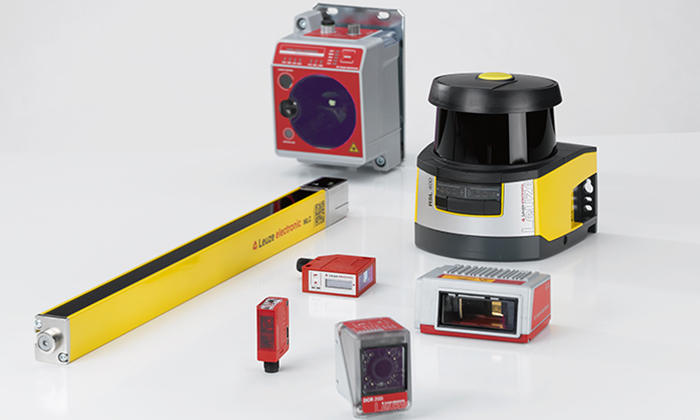
Depending on the distance to the hazard and the respective environmental conditions, different safety sensors are used. These include, for example, safety light curtains or multi-beam safety light barriers for securing access points and openings. For complex or variable protected zones, safety laser scanners are ideal, as they enable defined protective fields to be flexibly monitored.
To ensure a safety function that complies with standards, the safety sensors used are combined with suitable, safe switching devices or safety controllers. This enables reliable shutdown and monitoring functions to be implemented and ensures safety in the collaboration between humans and machines.
Safety requirements and standards for stationary robotics
The importance of safety at work and personal protection continues to grow with the increasing automation of work processes. The basis for designing safe machines and systems is a systematic risk assessment where potential hazards are analyzed and evaluated.
Numerous legal requirements, standards and regulations must be taken into account. The design of protective devices and the correct calculation of safety distances — for example, in accordance with the EN ISO 13855 standard — play a particularly important role in ensuring a safe response time and reliable protection against hazardous areas.
Sensor applications in detail
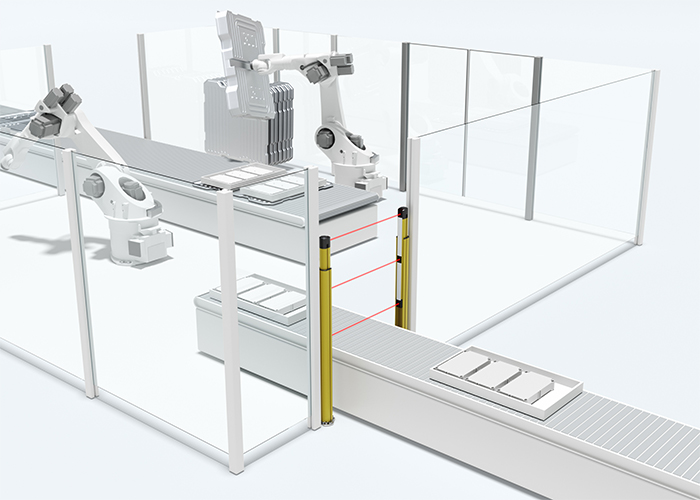
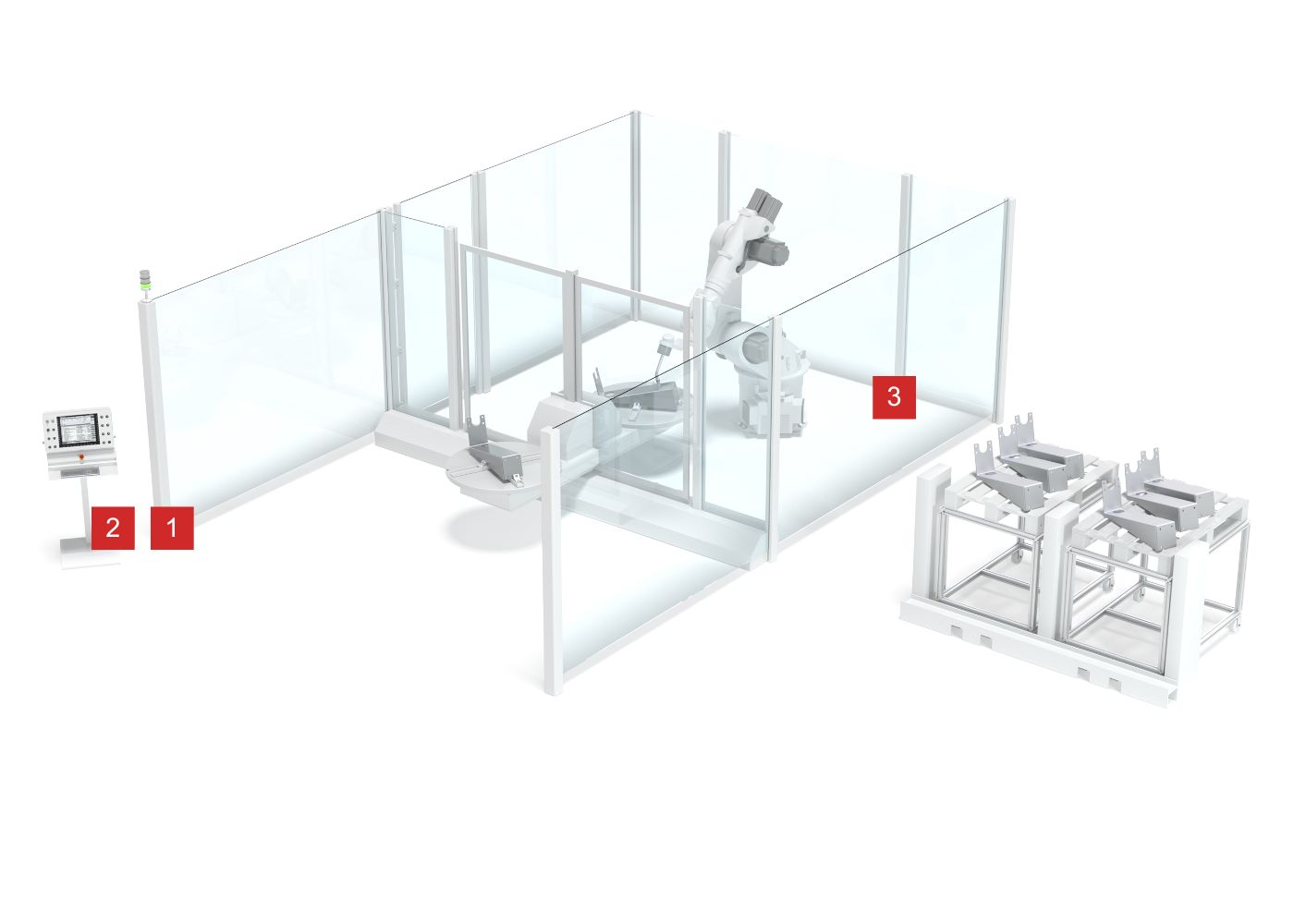
1. Access guarding for robotic work systems
Requirement:
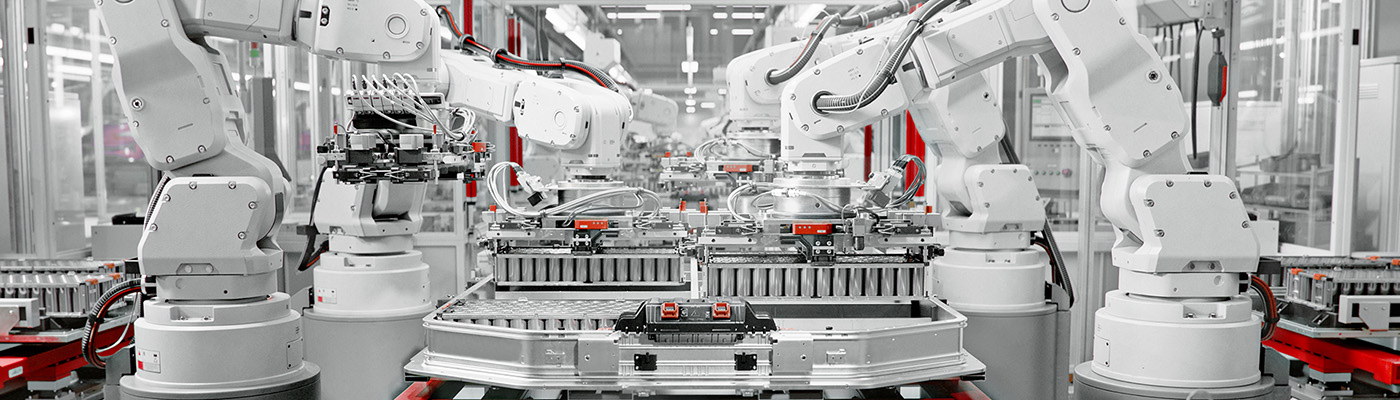
In interlinked robot cells, such as those used in battery production, components are transported via a conveyor system. Access guarding is required for all inputs and outputs.
Solution:
For person detection, MLD 500 multi-beam safety light barriers are used across the conveyor line. Variants with and without an integrated muting function are available. Configuration is easily performed via pin assignment.
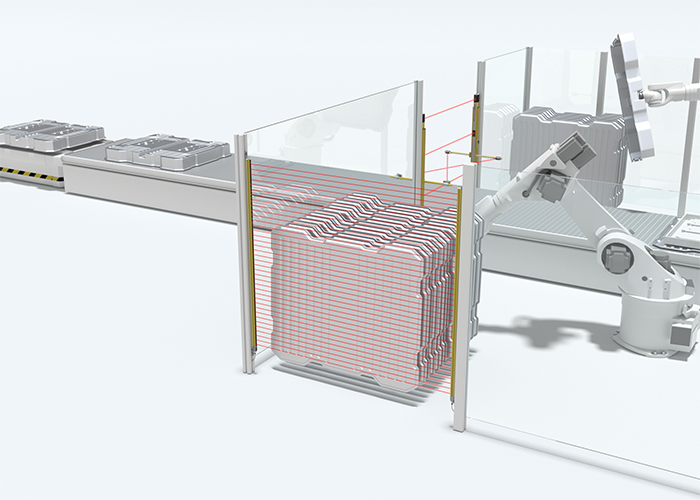
2. Access guarding with a small clearance
Requirement:
Operators must regularly supply robot-assisted work systems with materials or consumables. This requires access that is as simple and safe as possible, enabling the system to be efficiently loaded and replenished without unnecessarily disrupting the automated process.
Solution:
The ELC 100 and MLC 500 safety light curtains, with their high resolution, enable reliable finger and hand detection while requiring minimal space. With protective field lengths of up to 3000 mm and 1500 mm, respectively, they offer flexible solutions for a variety of safeguarding requirements.
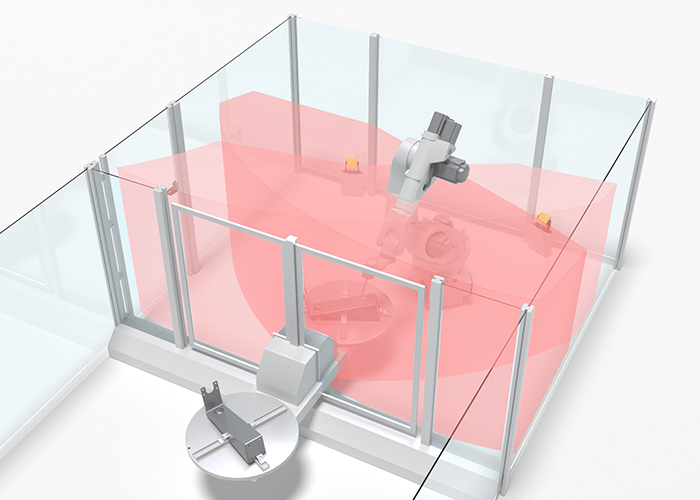
3. Restart protection and monitoring of hidden areas
Requirement:
To reliably eliminate hazards, the process, robot cell or machine must not restart until it has been ensured that no person is present in the working area or in hidden hazard zones.
Even under demanding environmental conditions — such as in the event of contamination, dust or welding sparks — safety, reliable functionality and high system availability must be consistently ensured.
Solution:
The LBK 3D safety radar system reliably monitors the presence of people using freely configurable protected areas, even under challenging environmental conditions. The radar technology used also enables stationary objects to be detected and differentiated between within the monitored area.
Thanks to the flexible configuration of detection angles and distance zones, the protected areas can be precisely adapted to the specific environment and application. The sensors’ low tolerance ensures reliable detection and minimizes false alarms.
The ability to combine up to six sensors via a single controller enables even larger or more complex plant structures to be safeguarded and offers versatile usage options in industrial safety technology.