



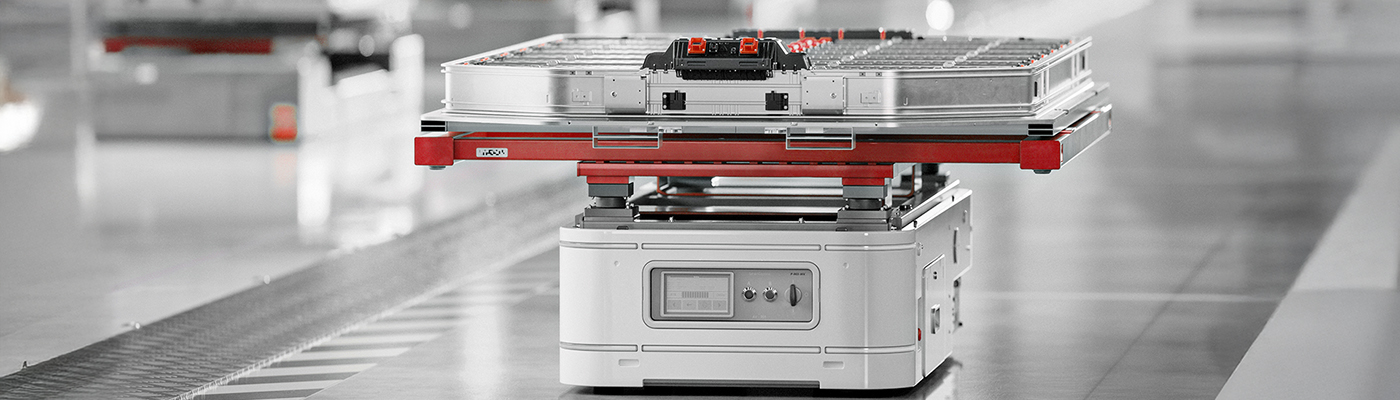
Detection and Positioning for Mobile Robots and AGVs
In automated processes, sensors act as the “eyes” of the automation system and perform a wide variety of functions. For example, they enable object detection, position monitoring, component identification, and precise alignment and positioning along the X and Y axes.
Numerous types of sensor technology are available to meet these various requirements. Depending on the application, diffuse sensors, ultrasonic sensors, optical distance sensors, position sensors, and inductive sensors are used for end position detection, among other things. Selecting the appropriate technology depends on the environmental conditions, the required accuracy and the specific automation task.
Sensor applications in vehicles
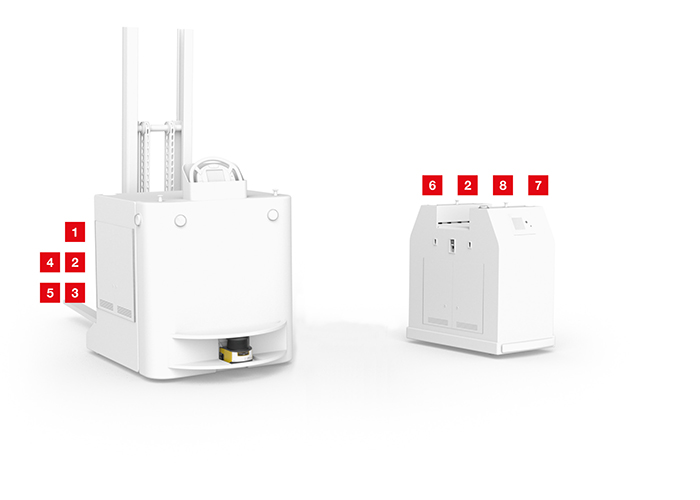
In mobile robots, sensors play a central role in reliably and safely executing individual process steps. Precise sensor signals are required for a wide variety of functions — from detecting a present load to determining a defined lifting position through to activating an integrated conveyor belt for loading and unloading operations.
Since mobile robots are primarily battery-powered and designed for maximum flexibility, compact designs, low weight and low energy consumption of the sensor technology used play a decisive role.
Sensor applications in detail
1. Vertical positioning of the load receptacle
Requirement:
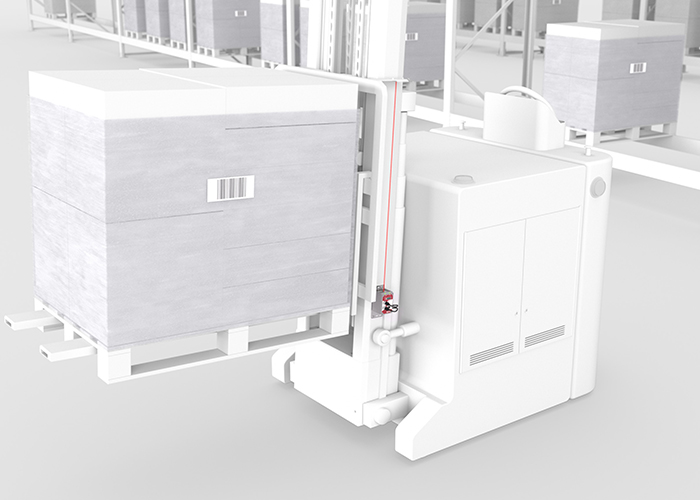
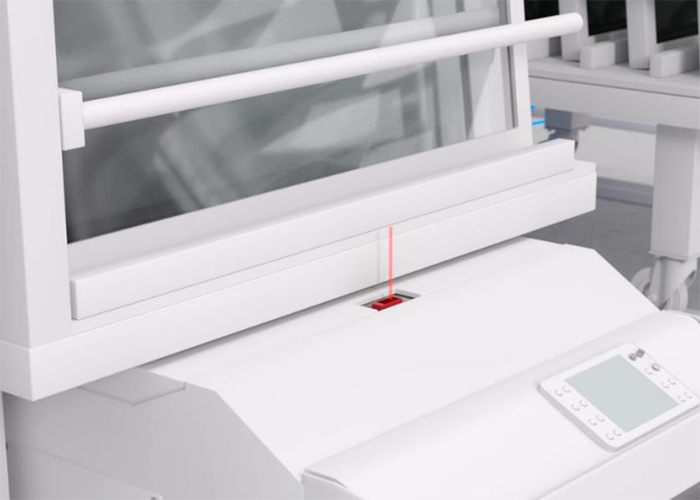
To ensure that the pallet or container is stored and retrieved reliably, the load receptacle of the AGV or mobile robot must be positioned accurately and repeatably at the correct height (lift axis).
Solution:
The AMS 100 laser positioning system delivers measurement data every 2 ms with an absolute accuracy of ± 2 mm. The data can be transferred to the control via a wide range of interfaces.
2. Presence/position monitoring for pallet localization
Requirement:
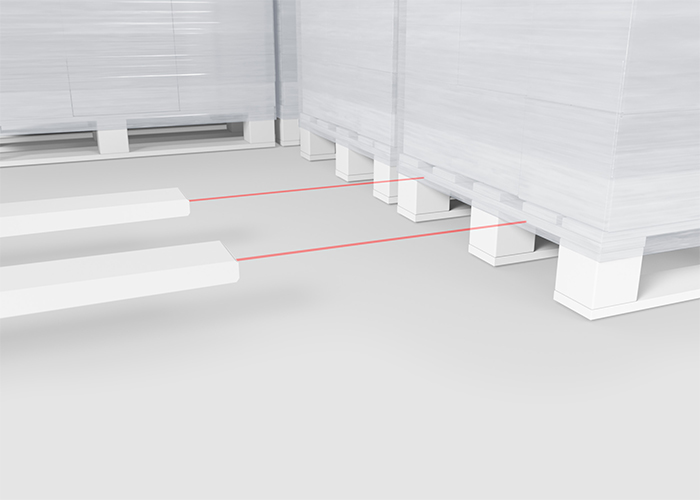
After transferring the container/pallet to the AGV or mobile robot, check whether the load carrier has been placed correctly. To this end, the presence of the load is to be checked at one or more defined positions.
Solution:
The compact HT 3C or HT 23 diffuse sensors reliably detect load carriers thanks to active background suppression and ambient light sensitivity. The HT 3C series includes variants for robust solutions, e.g. for the detection of objects with colored structure, objects with openings or highly polished surfaces.
3. Fine positioning of the fork
Requirement:
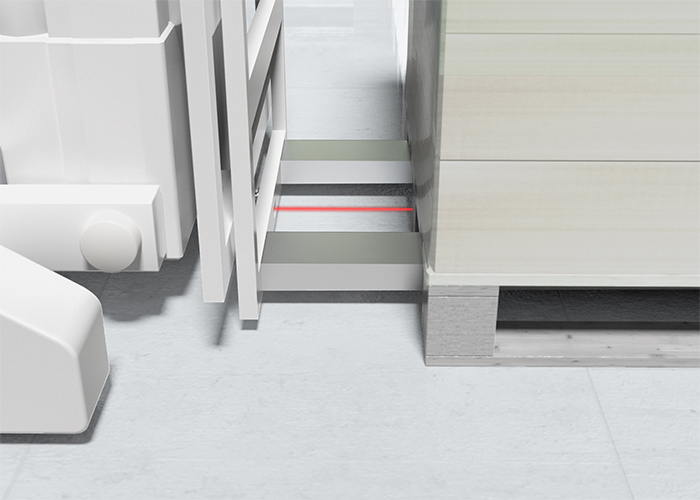
To automatically pick up a pallet or mesh box with the forks on the lifting device, the spaces between the feet must be identified and their accessibility detected.
Solution:
Compact diffuse sensors such as the HT 3C detect objects regardless of material and, thanks to their precise switching points, are also suitable for fine positioning, e.g. in a rack.
4. Determining the loading position on the fork
Requirement:
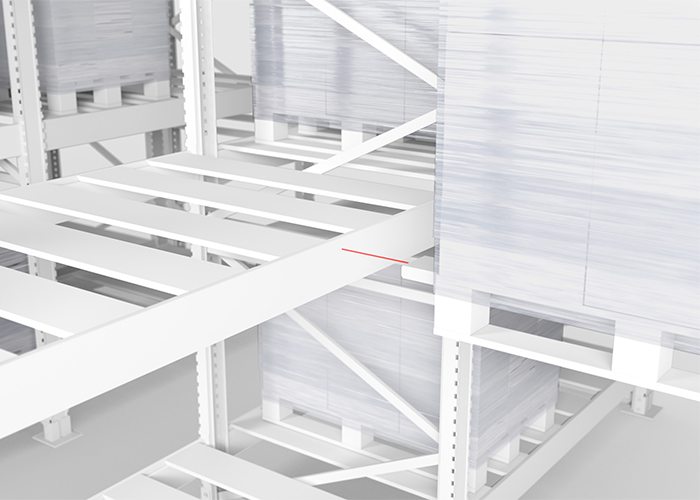
To reliably pick up a pallet or mesh box, it is necessary to measure the distance between the front face of the lifting device and the pallet in order to control the forward movement.
Solution:
The ODT 3C or ODT 25C distance sensors with TOF technology reliably detect colors and surfaces with high repeatability. This technology enables large operating ranges of up to several meters with high angle tolerance.
5. Detecting the bar position on the rack
Requirement:
For correct storage, the upper edge of the shelf bar where the object is to be placed must be detected.
Solution:
Compact HT 3C diffuse sensors with precise switching points, which can be integrated into the fork, are ideally suited for this task. Equipped with two switching points, these can also be used simultaneously for fine positioning on the fork.
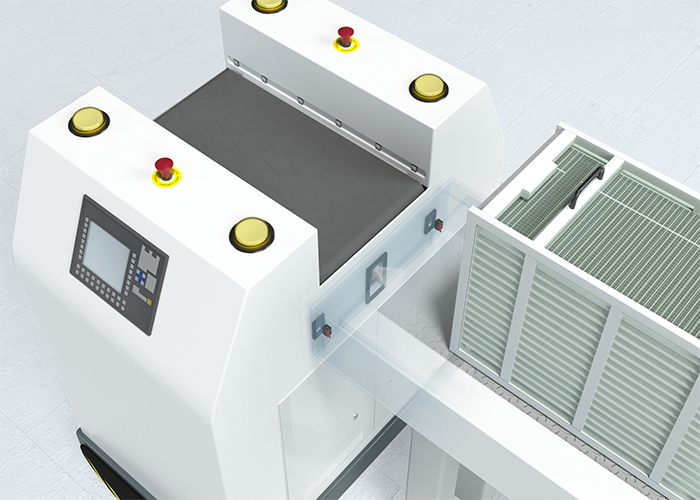
6. Transport control at automatic transfer points
Requirement:
Automated transfer stations from mobile to stationary and vice versa require non-contact signals to start conveyor belts for transfer.
Solution:
SR 5B throughbeam photoelectric sensors are suitable for this purpose. These compact sensors are immune to extraneous light and are easy to align thanks to their highly visible red light.
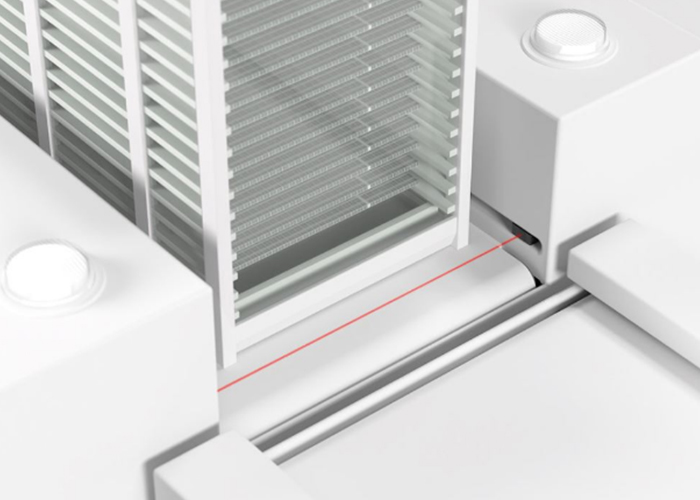
7. Presence of the cargo
Requirement:
To ensure reliable transfer, it must be verified whether the cargo has been completely transported to or from the AMR/AGV.
Solution:
Easy-to-integrate miniature retro-reflective photoelectric sensors PRK 23 or PRK 5B with extraneous light suppression operate with exceptional reliability.
8. High-precision fine positioning for transfer
Requirement:
In some applications, extremely high accuracy is required for positioning for material transfer, e.g. for transferring sensitive objects without any vibrations.
Solution:
The camera-based position sensor IPS 200 determines the position relative to a marker with high accuracy down to 0.1 mm. Deviations are output via Ethernet-based interfaces for readjustment of the load receptacle or AGV.