


Standards for sensors in sterile environments
Sterile medicinal products and medical devices must be packaged in contamination-free conditions; the component sterilization requirements are governed by the EU GMP Directive. The updated Annex 1, effective since the end of August 2024, means that the sterilization requirement applies not only to parts that come into direct or indirect contact with products, but also to all components that may disrupt “first air” – such as sensors or reflectors positioned above sterile components. Different challenges and opportunities arise for the use of sensors in pharmaceutical production and packaging depending on their type.
Stricter requirements
Strict requirements apply to the production and packaging of sterile medicinal products, as even minor errors can jeopardize patient safety. The latest revision of EU GMP Directive Annex 1, “Manufacture of Sterile Medicinal Products Guideline,” further tightens these requirements significantly. Annex 1 refers for the first time to the sterilization of components that interrupt the “first air”: Filtered air should reach the pharmaceutical product and any machine parts that come into contact with the product without interruption, because any interruption by components can pose a contamination risk. Components that interrupt the air flow must therefore be removed or, if this is not feasible, designed in such a way that they can be sterilized. Previously, decontamination was considered sufficient for sensors and reflectors installed in a way that interrupted first air. This included superficial cleaning using disinfectants or H₂O₂ vapor (vaporized hydrogen peroxide, VHP). Annex 1 “Manufacture of Sterile Medicinal Products Guideline” requires that these components are treated with validated, penetrative sterilization methods (e.g., autoclaving). This increases the effort and costs required for technology, documentation, and monitoring. This technology report explains the impact on sensor technology and how companies can put the new requirements into practice.
Annex 1: Key changes at a glance
1. Sterilization is handled more strictly
Not every disinfection or decontamination counts as sterilization. Instead, sterile procedures are required (no detectable living microorganisms present). Indirect contact parts and contact parts that interrupt first air must be treated as direct parts if they are part of the critical sterile environment.
2. Mandatory penetrative sterilization of all contact parts
It’s not just parts that come into direct or indirect contact with the product that need to be sterilized. This now also applies to components that interrupt first air. This means indirect contact parts that can disrupt airflow, including any components positioned above sterile parts and products, such as sensors. An exception is possible if a risk analysis within the framework of the Contamination Control Strategy (CCS) proves that cleaning or decontamination are sufficient and there is no risk of contamination.
3. Higher requirements for the sterilization method
Sterilization must be validated. For indirect contact and parts that interrupt first air, the procedure must be equivalent to the methods accepted for direct parts – penetrative sterilization methods such as autoclaving, moist or dry heat, gamma radiation, or ethylene oxide, are suitable. Direct and indirect contact parts as well as components that interrupt the first air are classified as “critical surfaces” according to Annex 1 and must therefore be sterilized. Surface decontamination, VHP-based methods, or steam disinfection are only permitted if evidence or risk analyses prove that these methods are sufficient. VHP-based methods are generally considered decontamination rather than sterilization, especially for closed or hard-to-reach surfaces.
4. More comprehensive risk analysis and documentation
It must be documented why and how indirect contact parts are sterilized. The risk assessment must show how critical the contact is and what influence it has on product sterility. In addition, the requirements for control and monitoring are increasing – especially during maintenance or servicing.
Contamination control strategy required
Annex 1 of the EU GMP Directive, which has been binding since August 2024, requires a comprehensive contamination control strategy (CCS) for the first time, which includes all areas of production – from raw materials to packaging. This is a document that takes a holistic and risk-based view of all contamination risks. Companies must assess the risk of contamination posed by a component, even if it does not come into direct contact with the product. Depending on the risk assessment, either validated sterilization must be performed, or an acceptable justification provided for why cleaning or decontamination is sufficient. This assessment and the measures taken must be fully documented and regularly reviewed. In technological terms, this means that the focus is shifting beyond traditional production facilities to include sensor technology, automation, and digital interfaces. First-air interrupting parts (e.g. sensors, reflectors, etc.) are now considered potential sources of contamination. This increases the requirements for the selection, integration and validation of these components.
| Aspect | Previous standard | Updated standard |
| Sterilization of first-air interrupting parts | Not mandatory, disinfection or decontamination often sufficient | Mandatory if part of the critical area or in contact with sterilized surfaces |
| Type of sterilization / procedure | Frequent surface disinfection / local procedures; less emphasis on penetration and validation | Penetrative sterilization procedures are required, or at least validation, verification and risk assessment if other methods are used |
| Risk analysis & documentation for first-air interrupting parts | Less clearly defined or applied inconsistently | Clearer, mandatory: Assess, document, and validate risk; provide evidence of ability to be sterilized if necessary. |
| Dealing with exceptions | More leeway for different products and environments, depending on stability, technology, etc. | Exceptions possible, but must be justified more strongly; alternative procedures only acceptable with validated control and risk assessment |
Indirect vs. direct contact vs first-air interruption
GMP Annex 1 regulates the requirements for cleaning, sterilization and monitoring of various contact parts. Direct product contact occurs when a component comes into direct contact with the product – such as filling needles, the inside of hoses or mixing tools. Such parts must always be sterile because they could directly contaminate the product.
Indirect product contact, on the other hand, means that a component does not directly come into contact with the product, but rather with components that touch the product later in the process (e.g. covers, stoppers, etc.).
A component is classified as first-air interrupting if the component does not touch the product directly but is located in the "first air" intake path. Contamination can occur via air, particles, droplets or proximity to exposed product surfaces. Examples include grippers, mounting brackets or cameras above the filling line. These components must also be sterilized.
Overview: Product contact, risk & cleaning/sterilization requirements
| Contact type | Example components | Contamination risk | Typical measure / cleaning | Sterilization required? |
Direct product contact | Filling needle, product pipe, inner surfaces of tanks, dosing pistons, transfer hoses, agitators | Very high – direct introduction of microorganisms or particles into the product | Penetrative sterilization (e.g. autoclave, steam [SIP], moist / dry heat) | Yes, always |
| Indirect product contact via components | Systems that feed stoppers, caps, closures or filters after they have been sterilized | High – contamination can occur indirectly via components | Penetrative sterilization (e.g. autoclave, steam [SIP], moist / dry heat) | Yes, always if components are not subsequently sterilized |
| First-air interruption | Grippers, robot arms, sensors, cameras, mounting brackets, carriers over open product surface, cap transfer systems. Component does not come into direct contact with the product but is located in the “first air” intake path and may pose a contamination risk to overall sterility through air, particles, droplets, or proximity to exposed product surfaces. | Medium to high – can transfer particles or microbes to the product via the air | Penetrative sterilization or validated alternative (e.g. VHP only with verification) | Yes, or, in exceptional cases, treated using a validated alternative method (comprehensive risk analysis required). |
| No product contact, no proximity to the exposed product | Housing, motors, external covers, HMI, cables outside the ISO A/B range | Low – not a realistic transmission path | Regular surface cleaning, no sterilization necessary | No |
Significance for the sensor technology used
The position and type of sensors and reflectors play a key role in complying with the new Annex 1 requirements. Sensors or reflectors mounted above the product are considered contact parts that interrupt first air. They must be sterilized by SIP (sterilization in place) or autoclaving. In practice, ultrasonic sensors for filling level measurement and retro-reflective photoelectric sensors with reflectors above the product have often been used because they offer the necessary operating ranges. It is precisely these solutions that are now critical: reflectors and ultrasonic sensors often cannot withstand the high temperatures and conditions of sterilization. Even if they were technically suitable for sterilization, this would involve considerable additional work and costs – the sensors and reflectors would have to be removed for autoclaving.
Hygienic time-of-flight sensors in response to Annex 1
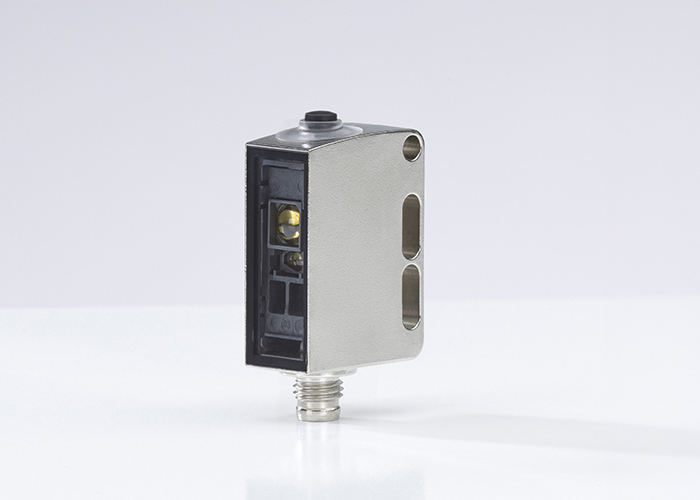
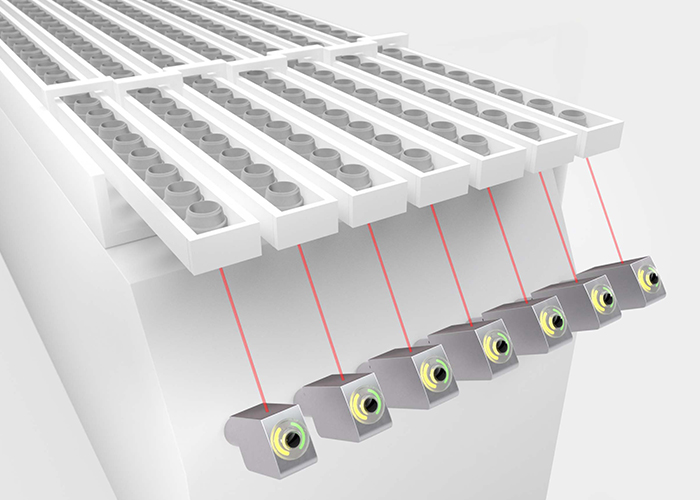
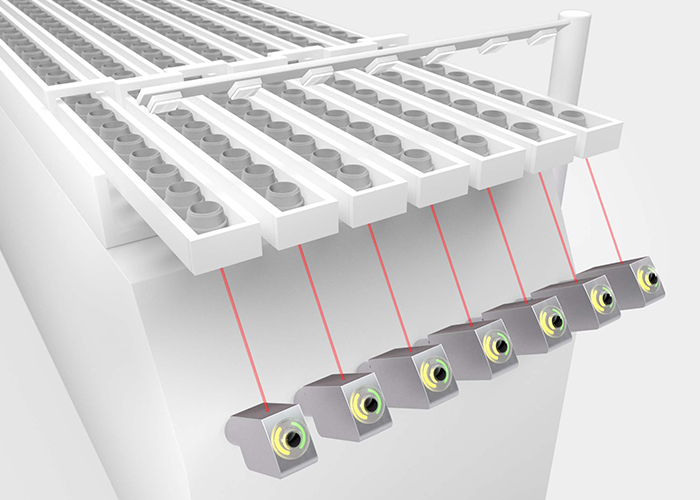
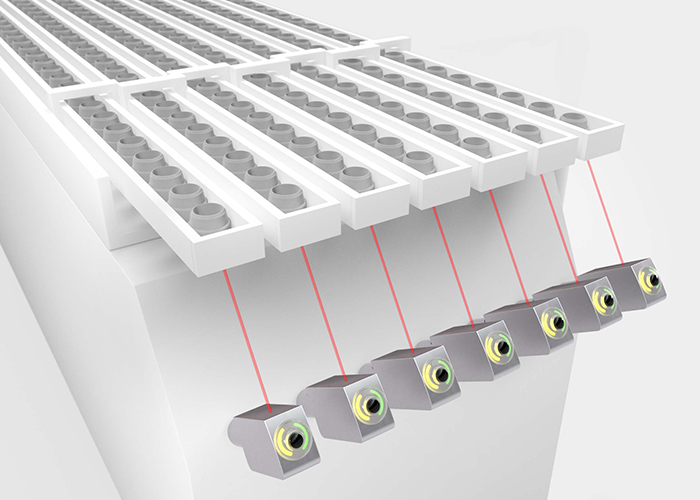
Modern optical sensors based on ToF (time of flight) such as the ODT53CL1-2M from Leuze provide significant advantages in relation to Annex 1: Thanks to their long operating ranges and stable detection behavior on a wide variety of object surfaces at different angles, the sensors can be mounted on the side or underneath the product and at considerable distances. As a result, they have no direct, indirect or first-air interrupting contact with the sterile product they detect – for example a stopper plug – and therefore do not need to be sterilized. The compact design, as offered by the 53C and 55C sensor series in a stainless-steel housing, is also an advantage, as space is often limited in pharmaceutical plants. Where sensors enable the evaluation of measurement values via IO-Link, system operators also benefit from additional process data. This makes control and verification in accordance with Annex 1 easier.
Summary
The new Annex 1 requirements make the careful selection and integration of sensor technology essential. Hygienic, flexibly mountable stainless-steel sensors from Leuze help you to implement the specifications safely and efficiently. Our experts will be happy to advise you and work with you to find the right solution for maximum process reliability and compliance.
Source: EudraLex - Volume 4 - Good Manufacturing Practice (GMP) guidelines