







Sensor solutions for carton packaging
In secondary packaging, individual products that have already been packaged are consolidated into cases or placed in cartons for efficient handling. The range of applications for sensors for carton packaging is diverse: Before final packaging, for example, it must be ensured that packages are completely filled, packages are transported in the correct orientation, and that cartons are securely sealed.
In cartoning machines, sensors assist, among other things, with erecting the cartons, loading the grouped products, and verifying that the cartons are filled correctly. In addition, they enable the precise measurement of stack heights as well as the detection and checking of the product stacks’ position, thereby contributing to a reliable and efficient packaging process.
Sensor solutions throughout the cartoning process
Even the preparation and feeding of cartons involve numerous sensor applications. Modern sensor solutions not only enable reliable object detection, but also provide additional information for positioning and process control.
In subsequent packaging processes, sensors assist with completeness monitoring of package contents, monitoring sealed cartons, and collecting relevant measurement data for downstream processes. In addition, they enable the measurement of shipping carton volumes, the inspection of closure and adhesive tape applications, and the reliable detection of damaged load carriers and transport containers.
Click on the numbered applications to learn more about the respective sensor solutions.
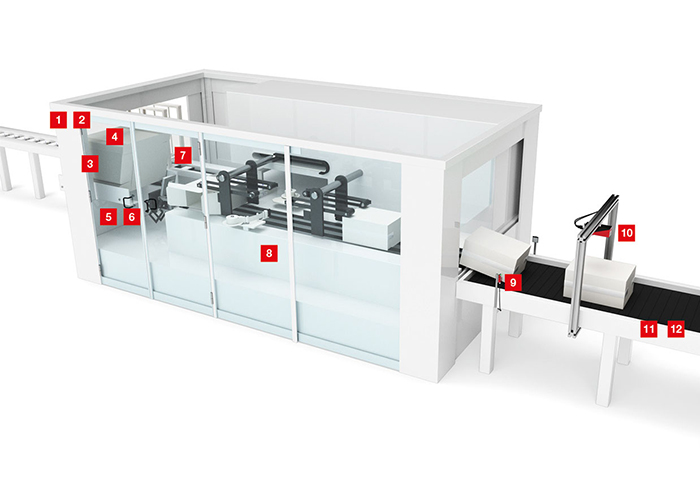
Application areas in carton packaging
Applications include tasks related to packaging materials, carton quality and closure inspections, as well as safety applications designed to ensure safe working conditions.

Applications for packaging materials
Stack positioning
Requirement:
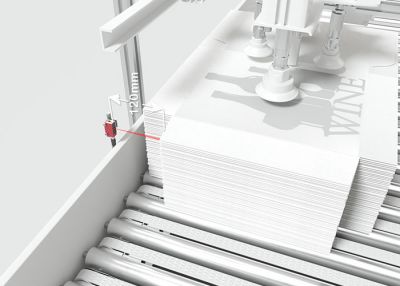
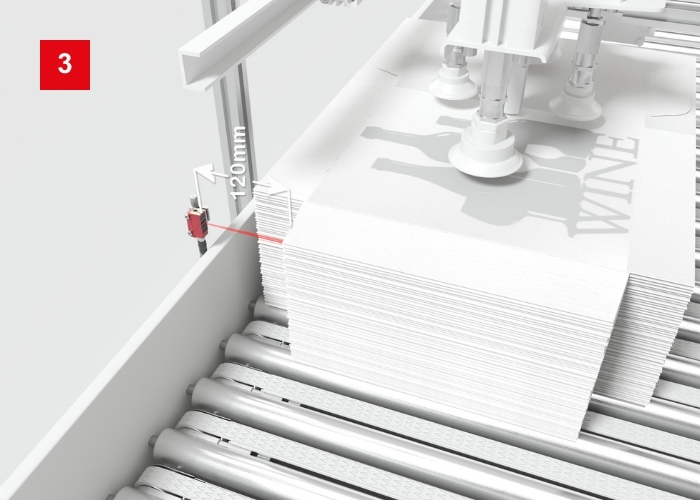
Carton blanks are supplied in stacks and are then automatically destacked, separated, and fed into the gluing and folding process. To ensure that the downstream processes run smoothly, the stack must be detected at a defined position on the conveyor belt.
Solution:
With its switching sensor function, the compact ODT 3C distance diffuse sensor detects the presence of the carton stack. At the same time, the measuring sensor function allows the exact position to be determined, which can be made available via IO-Link for further processing.
Position and presence control
Requirement:
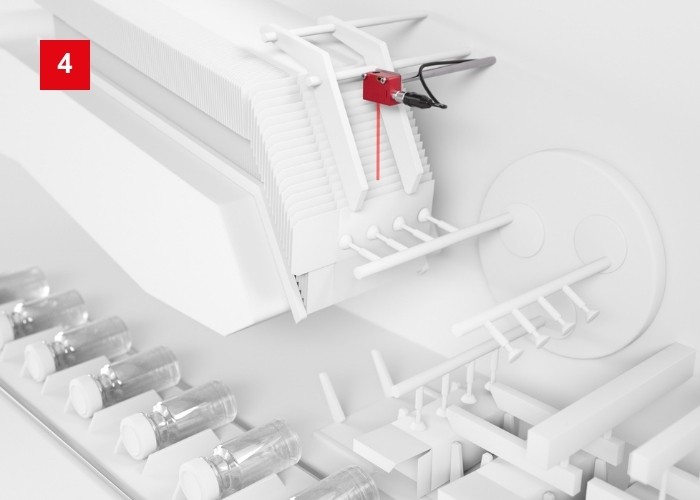
In a cartoning machine, the fill level of the folding box magazine is to be detected. The detection should be as independent of color and surface as possible.
Solution:
The precisely adjustable HT 3C or HT 25C diffuse sensor with background suppression and visible light spot are suitable for position and presence control. Variants with different light spot shapes are available. Format changes with distance changes can be made with the HT 3C.3 via the IO-Link interface.
> Learn more about diffuse sensors with background suppression
Measurement of stack heights
Requirement:
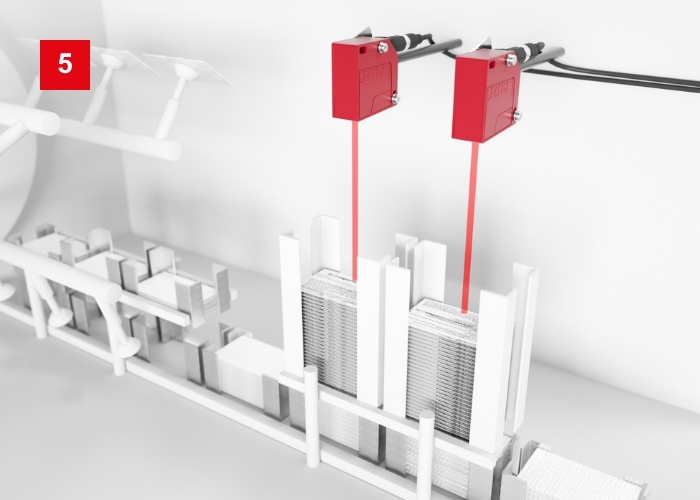
Primary packaging is stacked in the magazine of a packaging machine. To ensure that the stack contains the correct quantity, its height must be monitored. This requires sensors with high resolution and accuracy as well as a precise and easy-to-position light spot.
Solution:
The ODS 9 measuring sensors with staggered operating ranges and laser class 1 can be used easily and flexibly for measuring stack heights. The distance value is output as an analog current or voltage signal. The IO-Link interface ensures fast integration as well as additional parameterization options.
Detection of positions
Requirement:
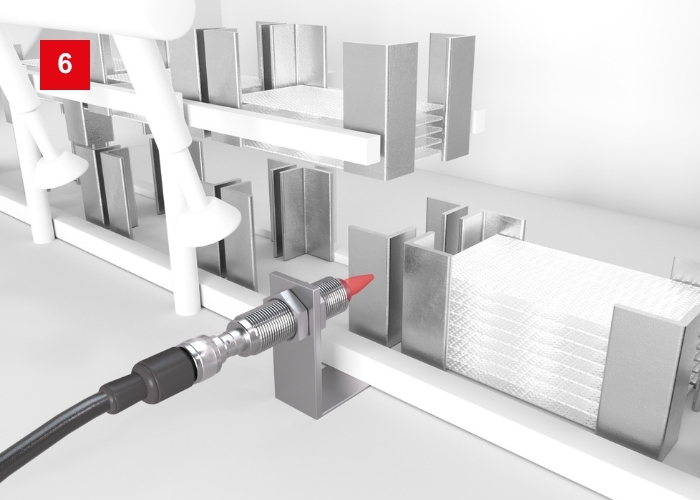
Primary packaging is often supplied and fed via magazines. To ensure collision-free movement and precise control of the feed, the position of the magazines or feeder fingers must be detected.
Solution:
Inductive sensors are used for reliable position monitoring of the metallic magazine structures. The IS 288 and IS 208 inductive sensors are ideally suited for this application thanks to their compact design and defined switching distances.
Quality control applications
Checking content
Requirement:
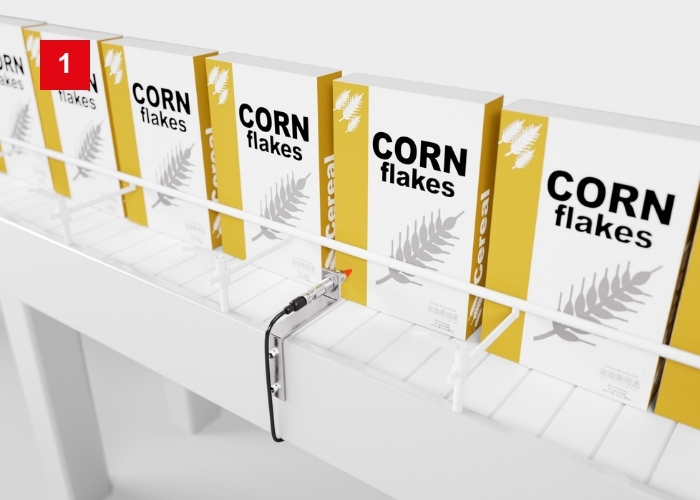
To ensure process quality, it is necessary to verify that the intended contents are inside the carton. Capacitive sensors are particularly well-suited for this inspection task, especially when dealing with opaque packaging.
Solution:
For cartons conveyed in a single lane, the LCS capacitive sensors detect the contents through the packaging. Their compact, cylindrical design allows for easy and space-saving integration into the application.
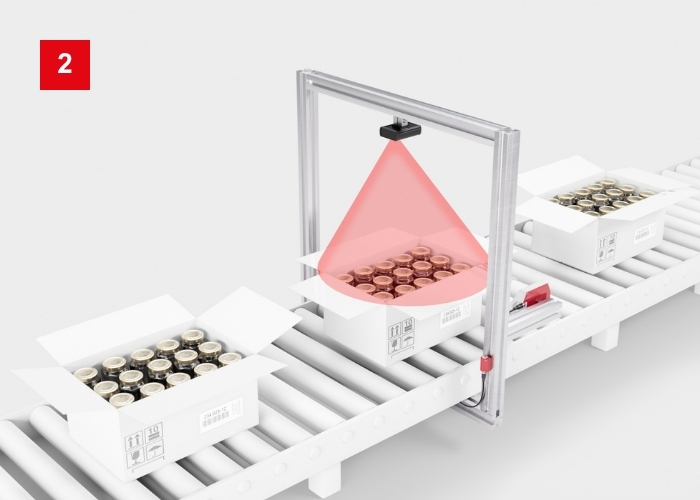
Documentation of carton content
Requirement:
Before a shipping carton is sealed, the content should be documented for tracking purposes. For this purpose, an image of the content is to be recorded and saved.
Solution:
The industrial LCAM 308 webcam records a single color image via external activation. In this way, the carton content can be documented and transmitted to a higher-level control via the Ethernet interface. Settings can be made via the integrated web browser.
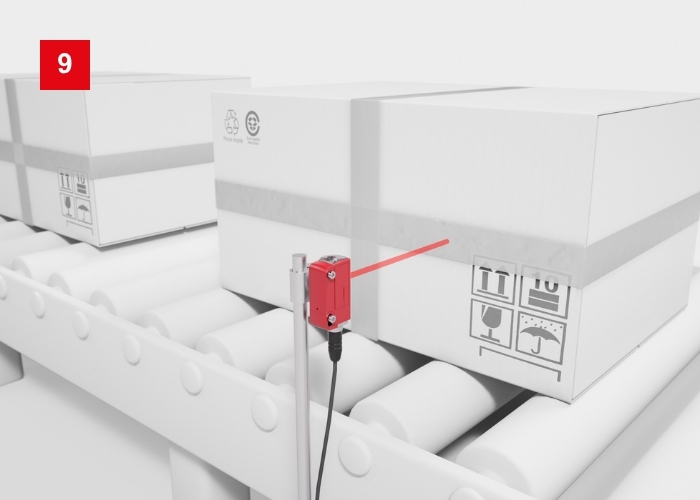
Gloss detection
Requirement:
Shipping cartons are automatically sealed with self-adhesive tape after filling. A sensor must detect the presence of the adhesive tape.
Solution:
The compact RK 3C diffuse reflection sensor (gloss sensor) reliably detects the glossy self-adhesive tape on the shipping carton.
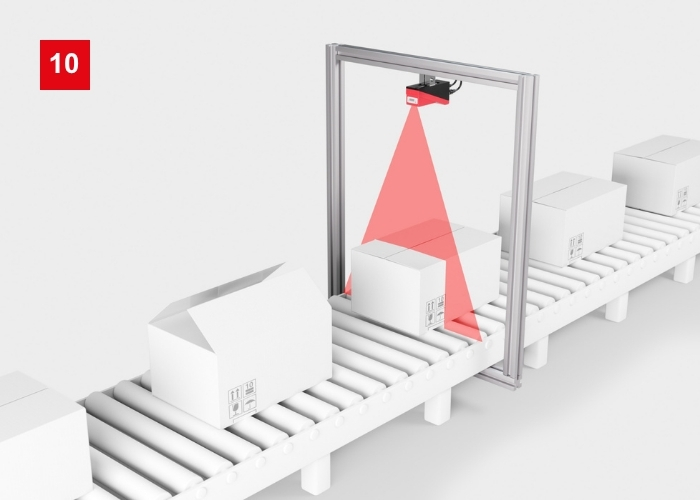
Closure inspection for cartons
Requirement:
After filling, the shipping cartons are automatically sealed. A testing device must be used to detect whether the flaps are closed and glued.
Solution:
The LRS 36 light section sensor cannot correctly detect closed cartons using a reference contour. Different reference contours can be saved in the sensor and selected via a digital interface. Due to the high measurement accuracy, even small deviations can be detected.
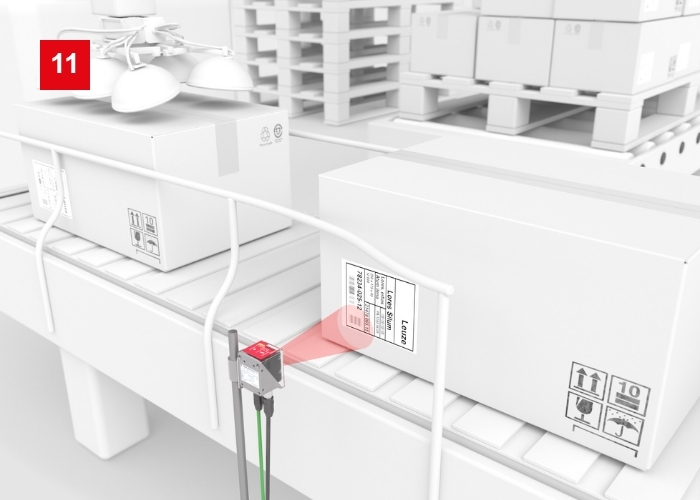
Checking the shipping label
Requirement:
After the shipping box has been filled and sealed, a label is affixed to it. The printed code must be checked for readability and correctness.
Solution:
The DCR 200i code reader can decode both bar codes and 2D-codes independently of their alignment, making it a very flexible solution. The code content is output via the integrated Ethernet interface.
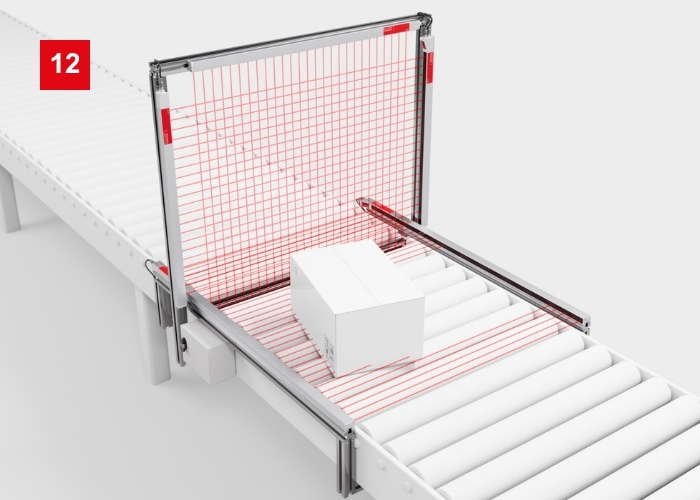
Shipping carton volume measurement
Requirement:
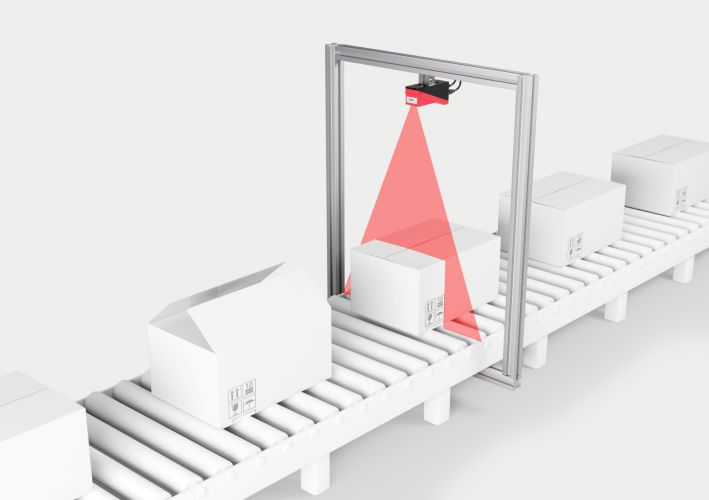
To ensure that shipping cartons are correctly assigned, their volume must be determined. For this, the dimensions of the incoming shipping cartons must be measured in all three dimensions.
Solution:
As objects pass through, the CMS 700i contour measurement system determines their height, width, length, orientation angle and position relative to the edge of the conveyor. The complete system contains all components required for installation and operation. Communication is Ethernet-based via PROFINET and TCP/IP.
Applications in occupational safety
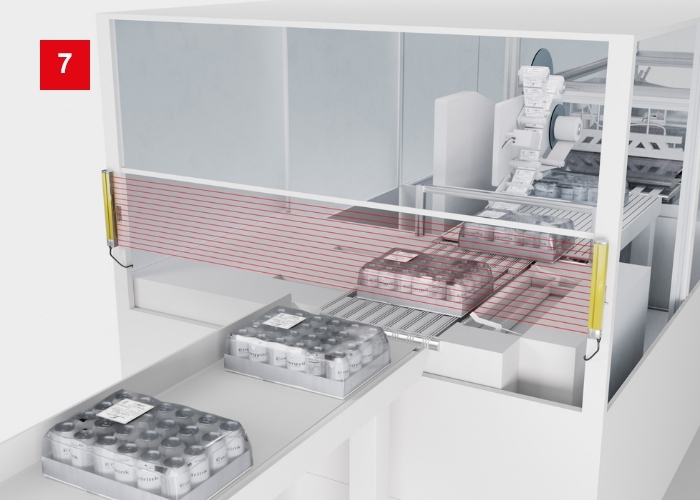
Safeguarding of points of operation in machines
Requirement:
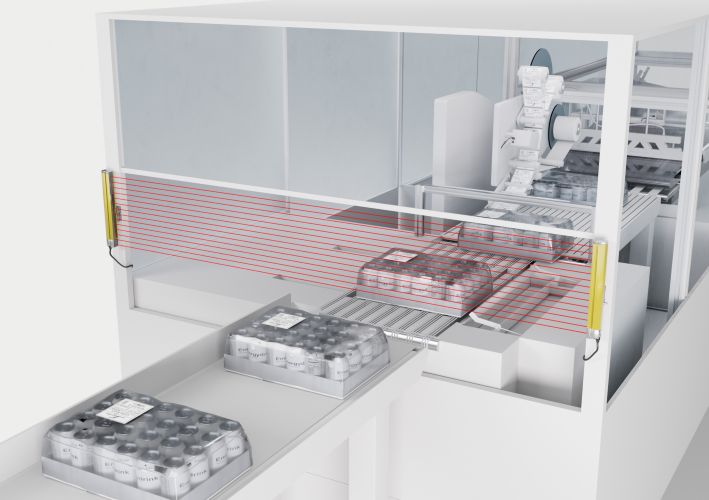
Packaging machines require openings at the infeed and outfeed to transport products. To prevent access to areas with hazardous movements, these openings must be properly safeguarded.
Solution:
To safeguard points of operation, the ELC 100 and MLC 500 safety light curtains are available with a wide range of protective field lengths and resolutions. While the ELC 100 is designed for cost-optimized machine concepts, the MLC 500 series offers additional flexibility for specialized applications.
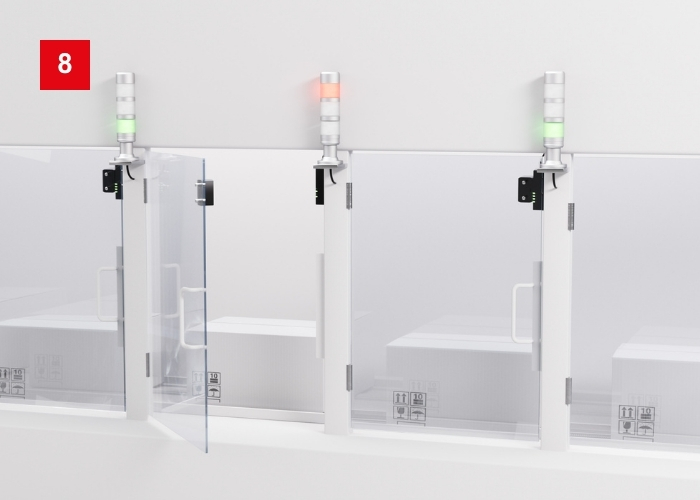
Monitoring of protective doors
Requirement:
Packaging machines are equipped with doors and flaps to provide access to various machine areas, for example, for cleaning or changing magazines. During operation, these access points must remain closed and be monitored for safety purposes.
Solution:
The RD 800 safety proximity sensors reliably monitor doors and flaps and, thanks to their RFID-encoded actuators, offer a high level of protection against tampering. Protection class IP69K and an operating temperature of up to 70°C means they are suitable for a wide range of applications. OSSD outputs and Performance Level PL e enable easy integration with the safety control. The TL305 tower lights clearly display the current system status.
Other topics in the packaging industry

Frequently asked questions about carton packaging
Since the products are generally placed in primary packaging in the preceding process step, there is usually no direct contact between the product and the sensor. As a result, the hygiene requirements, as well as the frequency and intensity of cleaning, are lower, allowing for a wider range of housing materials to be used.
Sensors support numerous process steps within cartoning machines. These include, for example, the feeding and positioning of carton blanks, checking product identification before insertion, monitoring proper filling, and verifying closure and transport processes. This allows processes to be automated and process errors to be detected early on.
Before a carton is sealed, it must be ensured that all intended products have been placed inside. Sensor systems can be used here to check the number, arrangement, or presence of the products. This helps prevent packaging errors and improves process quality.
Sensors enable continuous monitoring of various quality characteristics throughout the packaging process. These include, for example, checking the carton position, verifying closures, detecting damage, and measuring contours and dimensions. Deviations can be detected early, and downstream processes can be supported accordingly.
To ensure a smooth packaging process, cartons, packages, and stacks of products must be reliably detected, and their positions must be clearly determined. To this end, sensors detect the presence, position, distance, or height of the objects and provide the necessary information for handling, packaging, and palletizing processes. This ensures a stable material flow even with varying formats and products.