







Inductive sensors with IO-Link standard v1.1.4
With an IO-Link interface, sensors can be seamlessly integrated into automation systems. The inductive proximity switches with IO-Link interface are easy to operate, parameterize and monitor (condition monitoring). They can be operated both in standard I/O mode (SIO) and in IO-Link mode, offering maximum flexibility.
SIO mode is the standard mode. When connected to an IO-Link master, IO-Link mode is automatically activated, allowing the sensor to be operated and configured via the master. These configuration settings are retained even after the sensor is switched off.
Configuration options:
- Setting the switching distance and hysteresis
- Timer functions for specific applications
- Advanced functions such as temperature alarms and frequency monitoring
Application
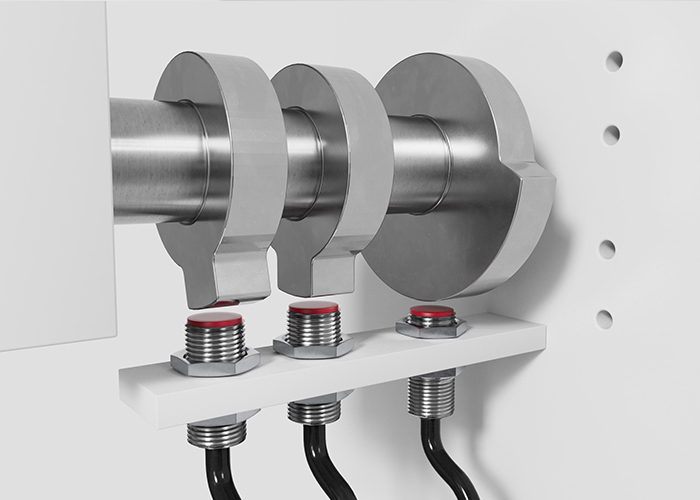
Speed measurement on a drive shaft
Requirement:
In a packaging machine, the speed is controlled by a transmission so that the machine moves at a specified speed. The speed is calculated by determining the detection frequency.
Solution:
The inductive sensors with IO-Link interface can be parameterized so that the detection frequency is output directly. The control no longer has to process the many thousands of switching signals and can regulate the frequency directly.
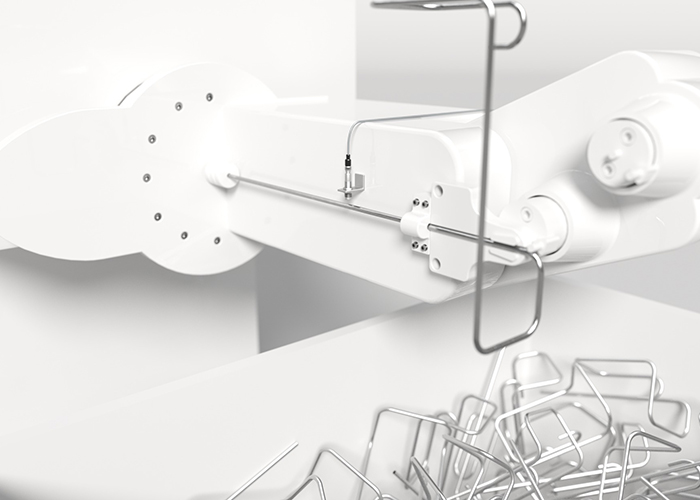
Monitoring the position of semi-finished metal products in production
Requirement:
In metal processing, the position of the semi-finished product is fundamental for a trouble-free production process. Deviations in the position or vibration of the material should be detected at an early stage before a machine stop is needed.
Solution:
The inductive sensors with IO-Link make it possible to monitor the target state (position, vibration) of the metallic semi-finished product by adjusting the parameterization. The interface can be used to quickly detect any unusual movements.
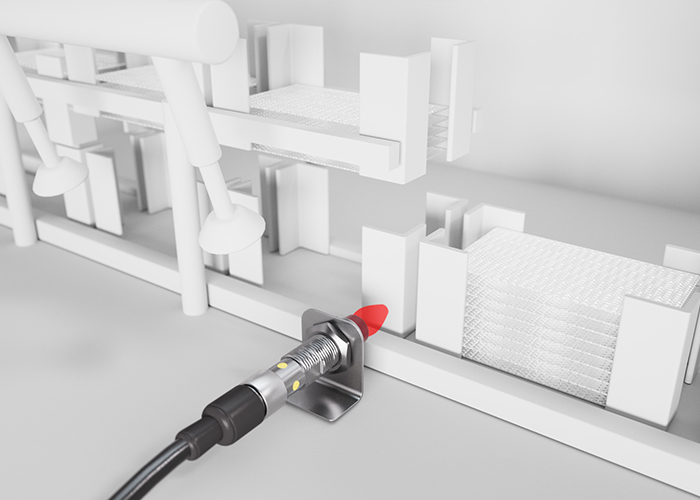
Adjustment of switching distance and hysteresis when checking the presence of material carriers
Requirement:
In packaging processes, the stacking and supply of primary packaging often takes place in magazines. The position of these magazines must be detected to prevent collisions and to control the feed. Detection should be reliable, even if the type of carrier changes or if the system vibrates.
Solution:
Inductive sensors with IO-Link detect the metal structures of the magazines reliably and precisely. If, for example, a new magazine type is introduced, the switching distance can be adjusted remotely using IO-Link. Even if shocks or vibrations cause malfunctions, changing the hysteresis, for example, can help.
The inductive sensors with IO-Link interface are available in 3 different designs:
- M8 made of stainless steel for flush installation, with M8.3 connector.
- M12 made of nickel-plated brass for flush installation, with M12 connector.
- M18 made of nickel-plated brass for flush installation, with M12 connector.