





Sensors for secondary packaging
In secondary packaging, individual products that have already been packaged are grouped into larger units and prepared for storage, transport, or display. Depending on the product and application, materials such as film, cardboard, or reusable containers are used.
Reliable sensor solutions support the various process steps and ensure safe and efficient operations even at high process speeds and with challenging packaging materials.
Applications of secondary packaging
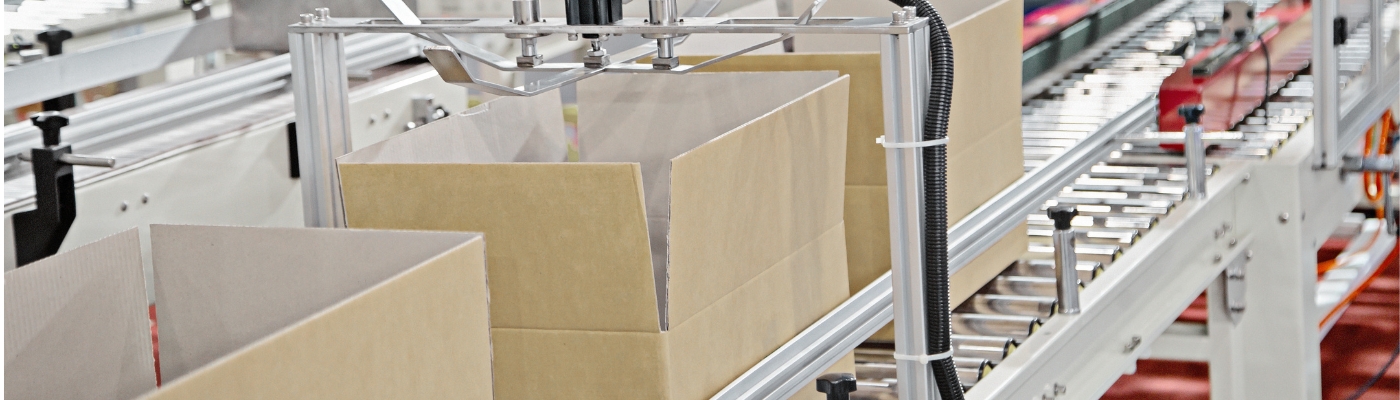
Secondary packaging involves various packaging steps: In package formation, individual products are grouped together and combined into larger units, for example, for packaging in film. Carton packaging, on the other hand, involves packing individual products or pre-formed packages into cardboard boxes for storage and transport.
Our sensor solutions support these processes – from reliable detection, grouping, and positioning to completeness monitoring and closure inspection. Even different colors, surfaces, shapes, and packaging materials are reliably detected.

Your benefits with our secondary packaging solutions

Comprehensive quality control
Reliable documentation and monitoring of packaging processes and contents

Accurate dimension measurement
Precise volume and contour measurement of cartons, packaging units, and packages

Reliable object detection
Reliable detection of products and packages in transparent and reflective films
Sensor technology for reliable secondary packaging processes
In automated packaging processes, a wide variety of products and materials must be reliably detected and processed. Varying colors and shapes, glossy or transparent surfaces, and high process speeds place special demands on sensor technology.
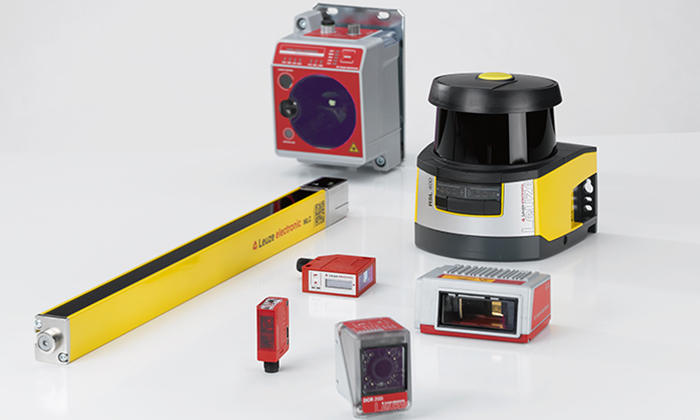
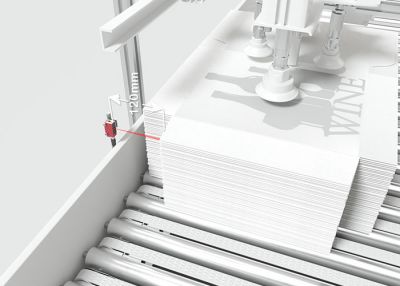
During package formation and grouping, sensors detect individual products and the resulting packages reliably and with precise positioning. Depending on the application, this may involve the use of reference diffuse sensors and unit pack sensors, distance sensors, measuring scanners, or light curtains.
In carton packaging, sensor technology supports various tasks throughout the process – from carton feeding and product positioning to completeness monitoring and closure inspections.
Image processing and measuring sensors also enable the documentation of the contents as well as the detection of the contours and volume of packaging units.
In this way, our sensor solutions support reliable and efficient processes throughout the entire secondary packaging process – from product grouping to transport-ready packaging.

Frequently asked questions about secondary packaging
This second packaging groups together objects that have already been packaged into a single package or serves as transport packaging. This secondary packaging is often made of cardboard.
The primary packaging itself and the machines may come into direct contact with the object. For this reason, strict guidelines regarding hygiene and cleaning apply, particularly when it comes to food products. With secondary packaging, there is no contact, and depending on the purpose, the focus is on presentation or ensuring smooth transport and storage.
Since the objects are usually packaged in the preceding step (primary packaging), there is generally no possibility of direct contact with the sensor. As a result, the hygiene requirements, as well as the frequency and intensity of cleaning, are significantly lower, allowing for a wider range of housing materials. Depending on the purpose of the secondary packaging, the focus is on presentation or ensuring problem-free transport and storage.
Here's an example from the snack industry: The potato chips are first weighed and then packaged in a bag (film). The grouped set of 20 bags is then packed into a carton as secondary packaging for further use. The carton is designed so that it can also be used as a display stand in a store.
Typical materials include coated paper and cardboard. In the B2C sector, point-of-sale displays are used primarily for advertising and brand presentation and usually have additional shipping packaging on top. In the B2B sector, however, cardboard packaging is mainly used to protect products during transport and storage. Accordingly, a simpler design is generally chosen here.