


Safety and transportation path safeguarding for mobile robots and AGVs
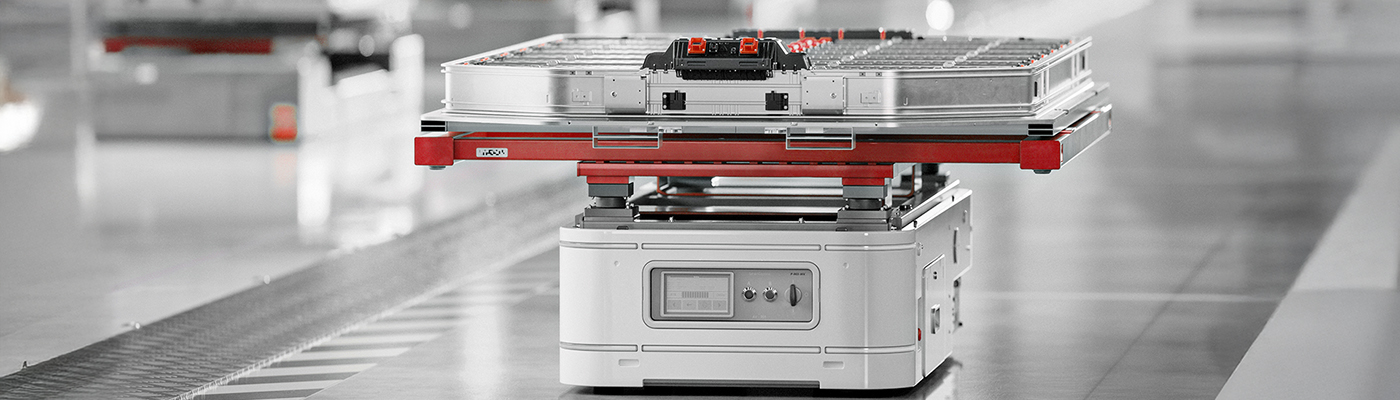
Safety at work is a key area of application, particularly for mobile robots and autonomous guided vehicles, due to their autonomous movement. This applies both to the area immediately surrounding the vehicle and to transfer and interaction zones. Being able to flexibly adapt safety zones to varying operating and environmental conditions is of crucial importance here.
Since people can cross the path at any point, high safety requirements must be met along the entire route. Reliable area safeguarding for mobile robots is often achieved using safety laser scanners. They enable the vehicle’s surroundings to be monitored in compliance with standards and thus make a significant contribution to ensuring safety at work for mobile robots.
Personal safety and safety along the route
As the automation of industrial workflows increases, it is becoming increasingly important to ensure safety at work and the protection of people. The basis for the design of safe machines and systems is a systematic risk assessment where potential hazards are identified and evaluated. Numerous standards and regulations must be taken into account in this process. The EN ISO 13855 standard is particularly relevant for calculating the required safety distance, as it specifies the positioning of protective devices with regard to people’s approach speed.
Sensor applications in detail
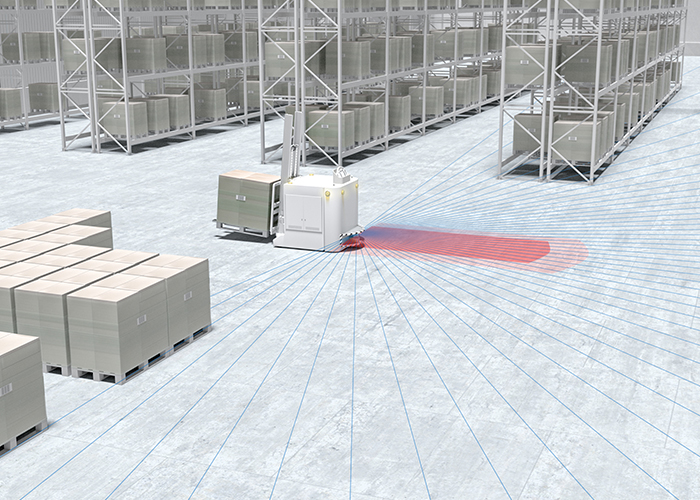
1. Safeguarding the transportation path and navigation
Requirement:
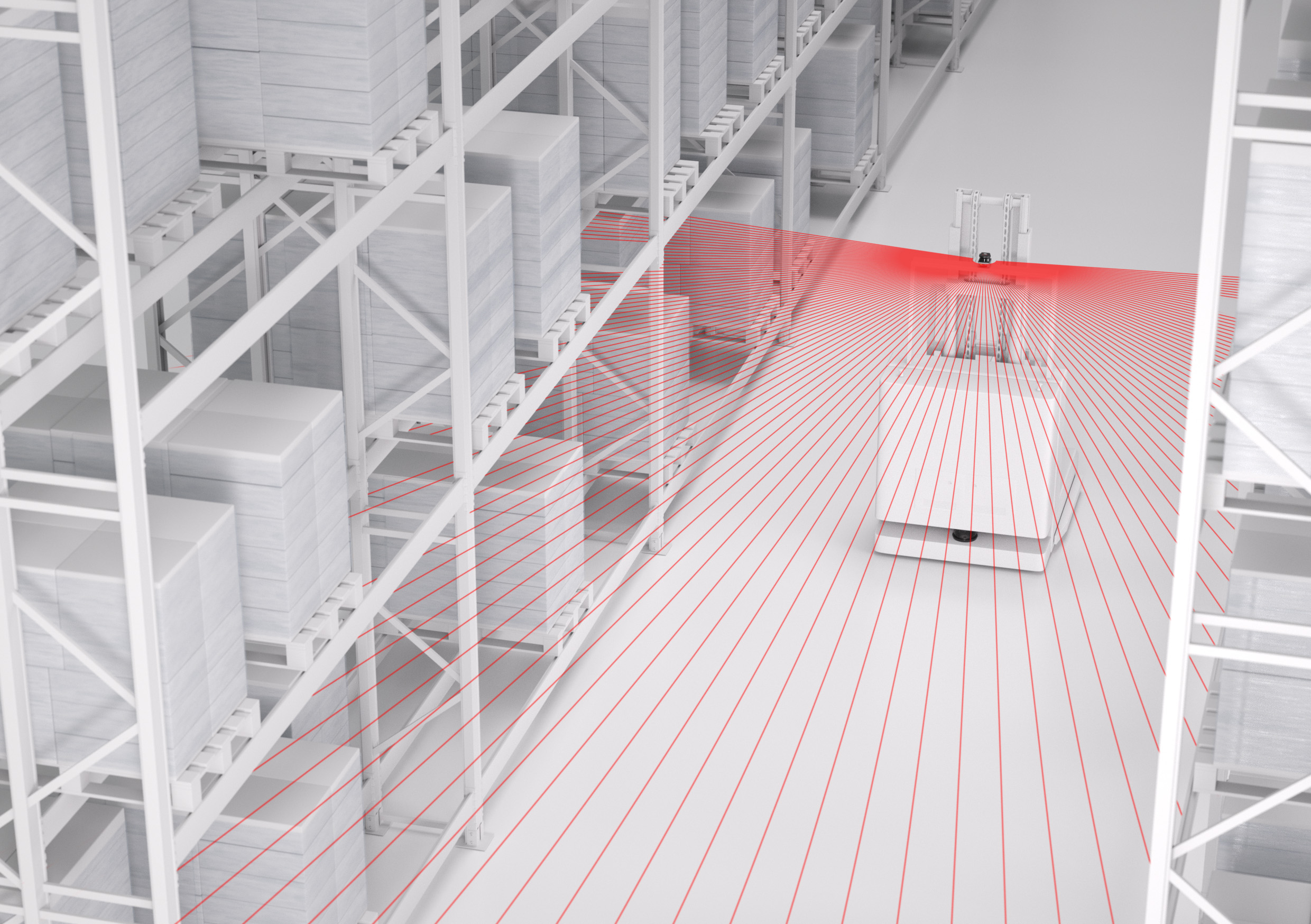
If the principle of natural navigation is used, the safety sensor should provide the measurement data for the navigation software in order to determine the environment in addition to safeguarding the transportation path in different driving situations.
Solution:
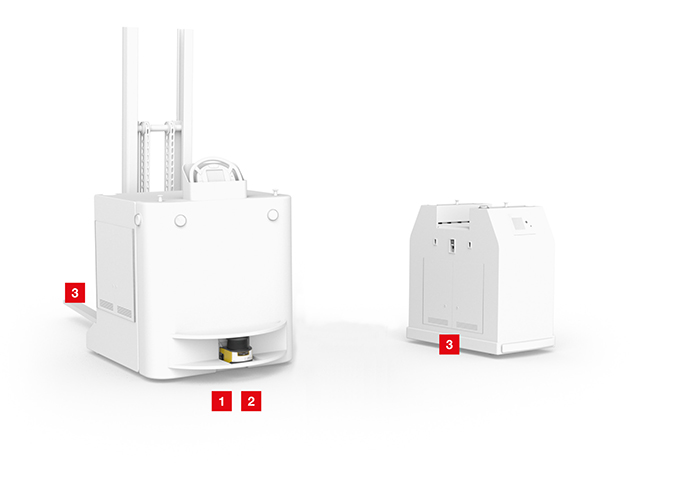
The RSL 200 / RSL 400 safety laser scanner merges safety technology and high-quality measurement value output (navigation) in a single device. It features up to 100 configurable and switchable field pairs. The measurement data have a high angular resolution of 0.1° or 0.2°, which allows a very accurate map of the environment to be created for autonomous vehicles. Alternatively, a device solely for navigation would suffice.
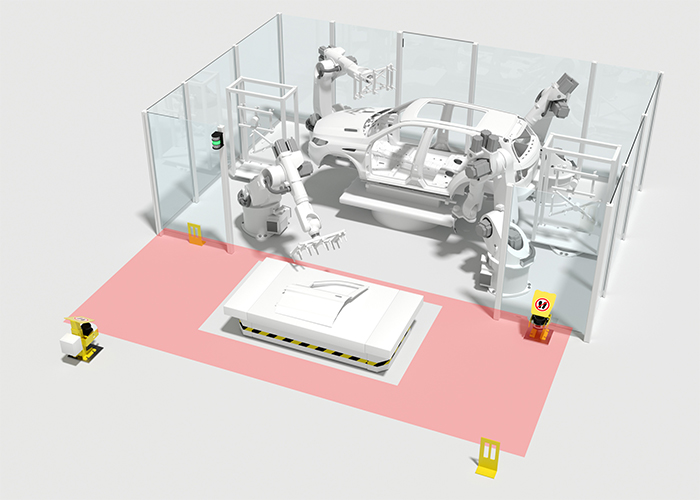
2. Safeguarding of the transfer station
Requirement:
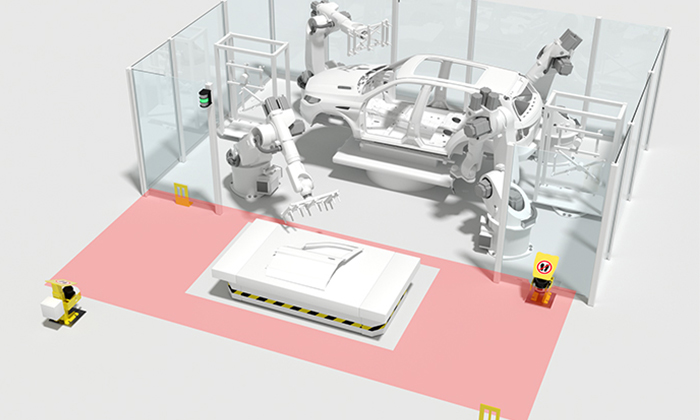
The hazardous area of the robot and the working range of the transfer station must be safeguarded against entry by persons during the entire process. The vehicle must be able to enter and exit the working range fully automatically.
Solution:
As a safety solution, the entire area of the transfer station is safeguarded with RSL safety laser scanners. Their protective fields detect the entry and presence of persons. When an AGV passes through, its outline is dynamically detected and hidden from the protective fields. This allows the AGV to automatically enter the station, transfer the material at the parking position, and then leave the station again. This means that the station remains as safe as can be at all times.
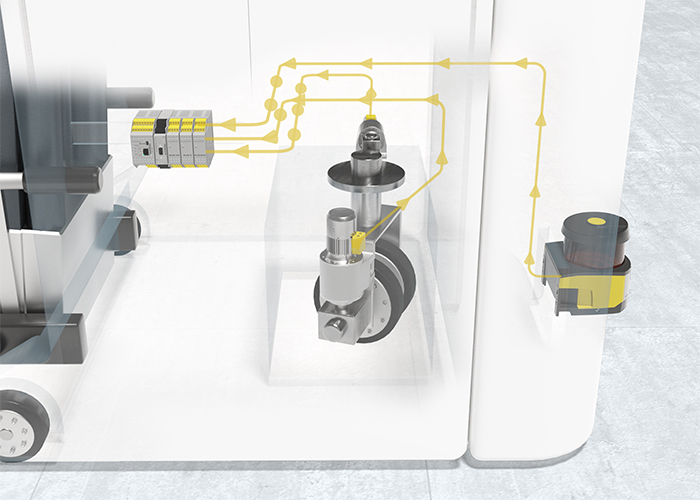
3. Safety function on the vehicle
Requirement:
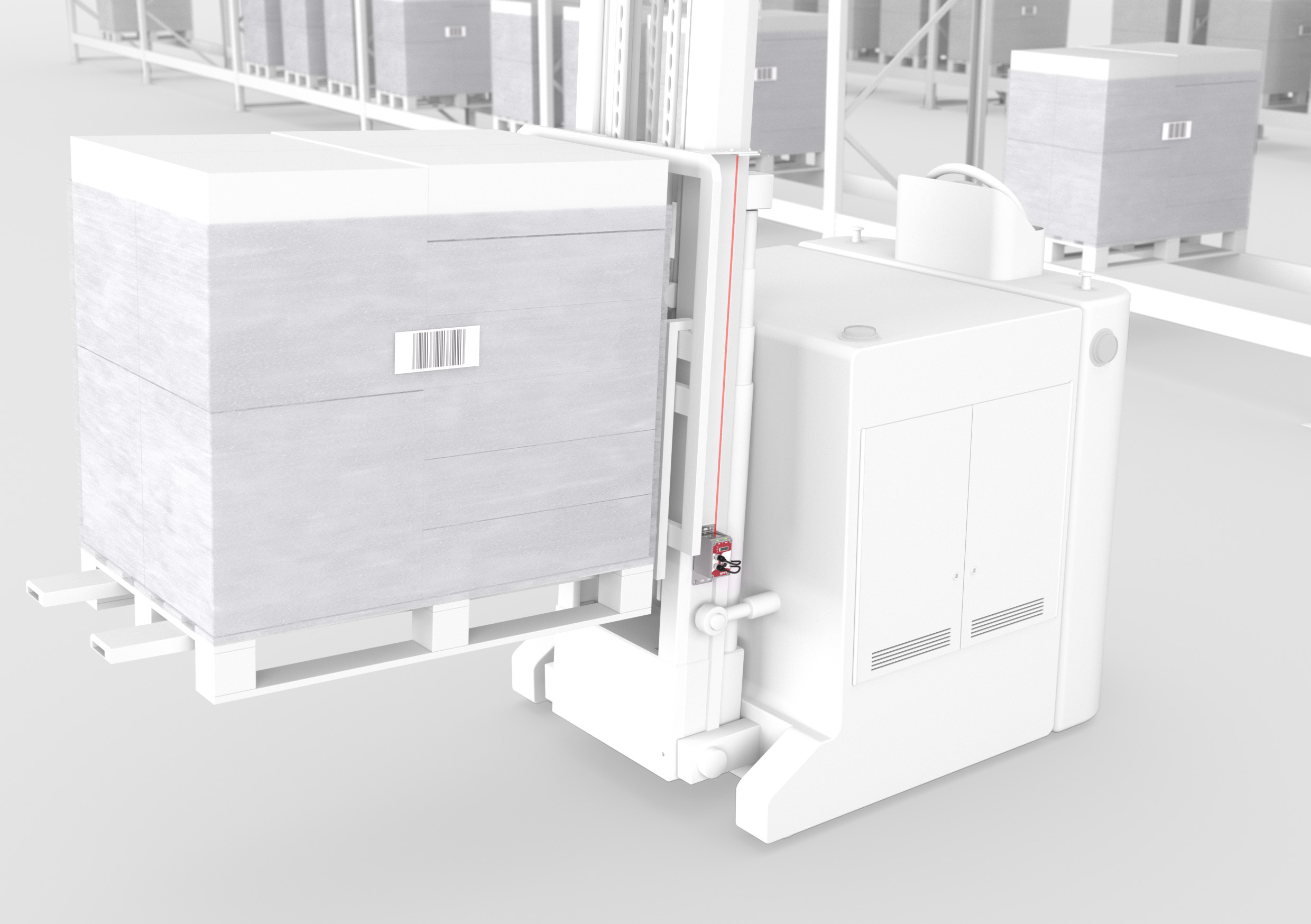
A safety controller is used to record and monitor safety-related parameters such as velocity, steering angle and other driving status data to ensure that the AGV/AMR is functionally safe and operates in a way that is safe for personnel.
Solution:
The compact and modularly expandable MSI 400 safety controller enables safety-related functions to be programmed intuitively and without a license, with the integration of multiple safety sensors. This makes it particularly well-suited for mobile robots or AGVs.