





Robotics – Intelligent Sensor and Safety Solutions for Industry
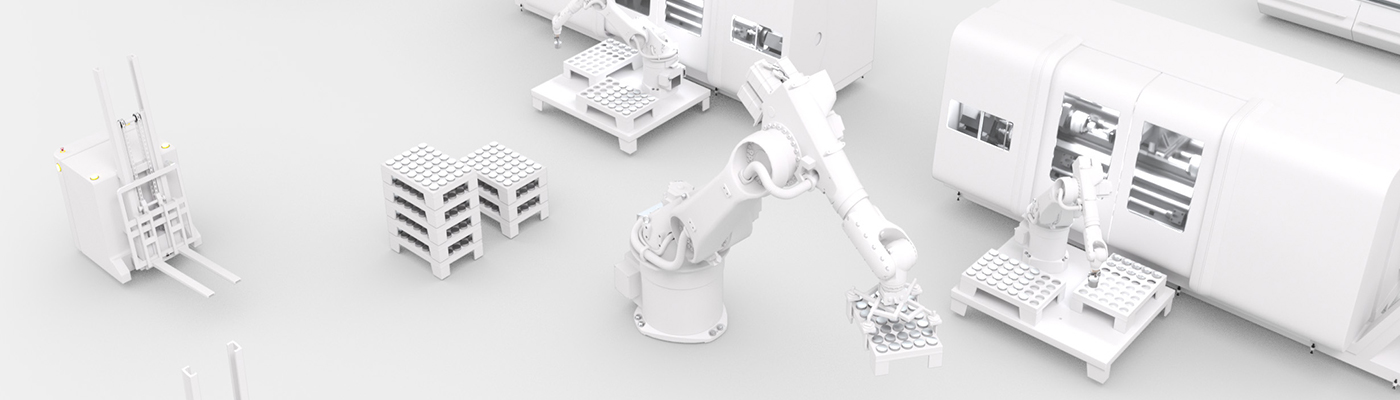
Industrial robots can be used in many ways when it comes to logistics and production processes. Depending on the specific conditions, a fundamental distinction is made between permanent, known as stationary, and moving, known as mobile, robotic applications.
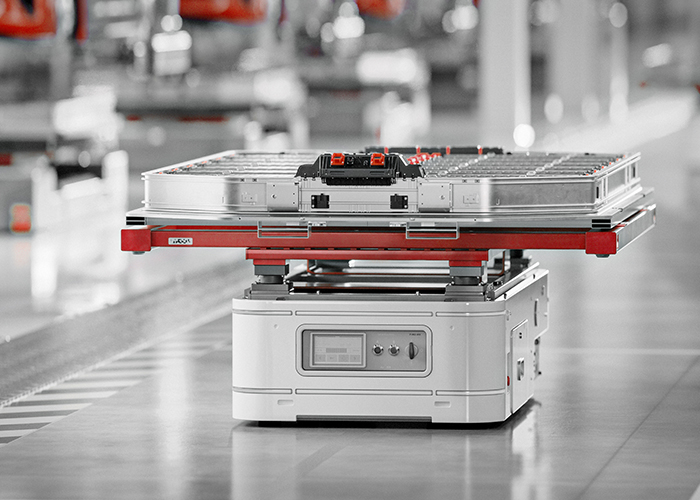
Due to increasing demands for flexible material flow in production, warehousing and order picking, new transport lines are being increasingly implemented using mobile transport systems and robots instead of rigid roller or belt conveyors. This allows changes to process workflows to be made quickly, efficiently and flexibly.
At the same time, the number of robot-assisted process steps in production cells — for example, for joining or assembling individual parts — is continuously increasing. This area of stationary and mobile robotics requires specialized sensor technology to be used to reliably perform automated tasks.
Sensor Solutions for Mobile Robots
Mobile robotics enables the flexible automation of transportation, logistics and industrial processes, ensuring efficient material flows, greater safety, and higher productivity in modern production and warehouse environments.
In this way, companies create flexible and future-proof automation solutions for industry and intralogistics.

Sensor Solutions for Industrial Robots
Stationary robotics enables the automation of production, assembly and logistics processes through the use of permanently installed robotic systems (robot cells). Modern sensor technology, networked control systems and integration with ERP and MES systems ensure efficient, precise and end-to-end process automation.
Whether it’s a manufacturing cell, production line or smart factory, stationary robots ensure precise operations, consistently high quality and maximum efficiency in industrial applications.
Questions about sensor solutions for robotics? We’d be happy to help you.
Frequently Asked Questions About Robotics
Industrial robotics refers to the use of automated, programmable robot systems in production and manufacturing that perform tasks such as material handling, assembly, welding or packaging. The focus is on increasing efficiency, quality and repeatability in industrial processes through the targeted use of automation technology. Another key component is safe human-robot collaboration, supported by modern sensor technology and safety solutions.
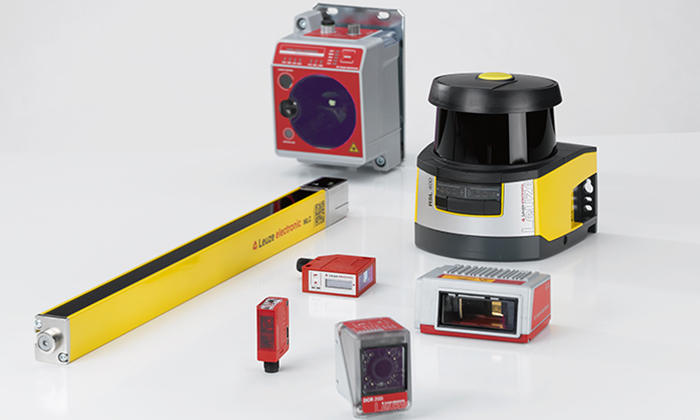
In robotics, various sensors are used to reliably detect objects and to secure access points and hazardous areas in industrial environments. With industrial robots, the focus is primarily on the detection and safe monitoring of work areas, while stationary collaborative robots (cobots) also use distance sensors to ensure safety in human-robot interaction. For mobile robots, AMRs and AGVs, navigation using laser scanners also plays a central role, with safety measures focused on reliably securing the transportation paths, in particular.
Mobile robotics encompasses self-driving and autonomous units that perform work and transport tasks independently. They are capable of determining optimal transportation paths, detecting obstacles and avoiding them autonomously. A key aspect is the safeguarding of the transportation path to ensure reliable operation. The choice of navigation method depends on the specific requirements and environmental conditions. Depending on the application, track-guided systems or free navigation methods, such as those based on reference points or contour recognition, are used.
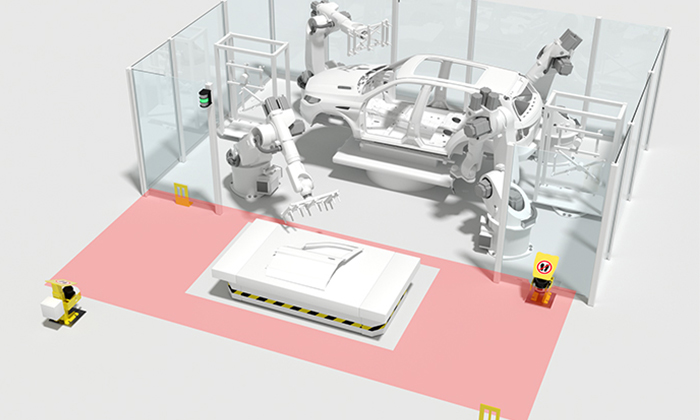
A typical example of stationary robotics is a permanently installed robot-assisted production cell. In terms of function, it resembles a complex, compact machine whose process sequences are automatically controlled using sensors. Due to the necessary access points and openings, appropriate measures must be taken to protect personnel and ensure operational safety. Compared to conventional machines, however, robot-assisted production cells are characterized by a high degree of flexibility. Adjustments — for example, to workpiece geometries, process sequences or the number of machining steps — can be made with relatively little effort.