



Sensor solutions for beverage filling
Beverage filling systems fill glass bottles, cans and PET containers in highly automated processes and at an impressive speed. In addition to high throughput, reliability and maximum system availability are key factors for an efficient production process. As the market leader in sensor technology for beverage filling, we offer customized solutions for all applications along the process chain – from filling, through labeling and packaging, to palletizing and shipping.
Beverage filling places the highest demands on the sensor technology used. A wide variety of container types must be reliably detected and processed. This requires specially optimized sensor solutions with very short response times that can reliably detect transparent objects and reliably distinguish between filled and empty containers.
Sensors along the filling process
A variety of optimally tailored sensor solutions are available to meet the diverse requirements of beverage filling. Reliable detection of transparent media depends in particular on a high level of detection accuracy. An integrated tracking function compensates for potential contamination of the optics, thereby contributing to higher system availability.
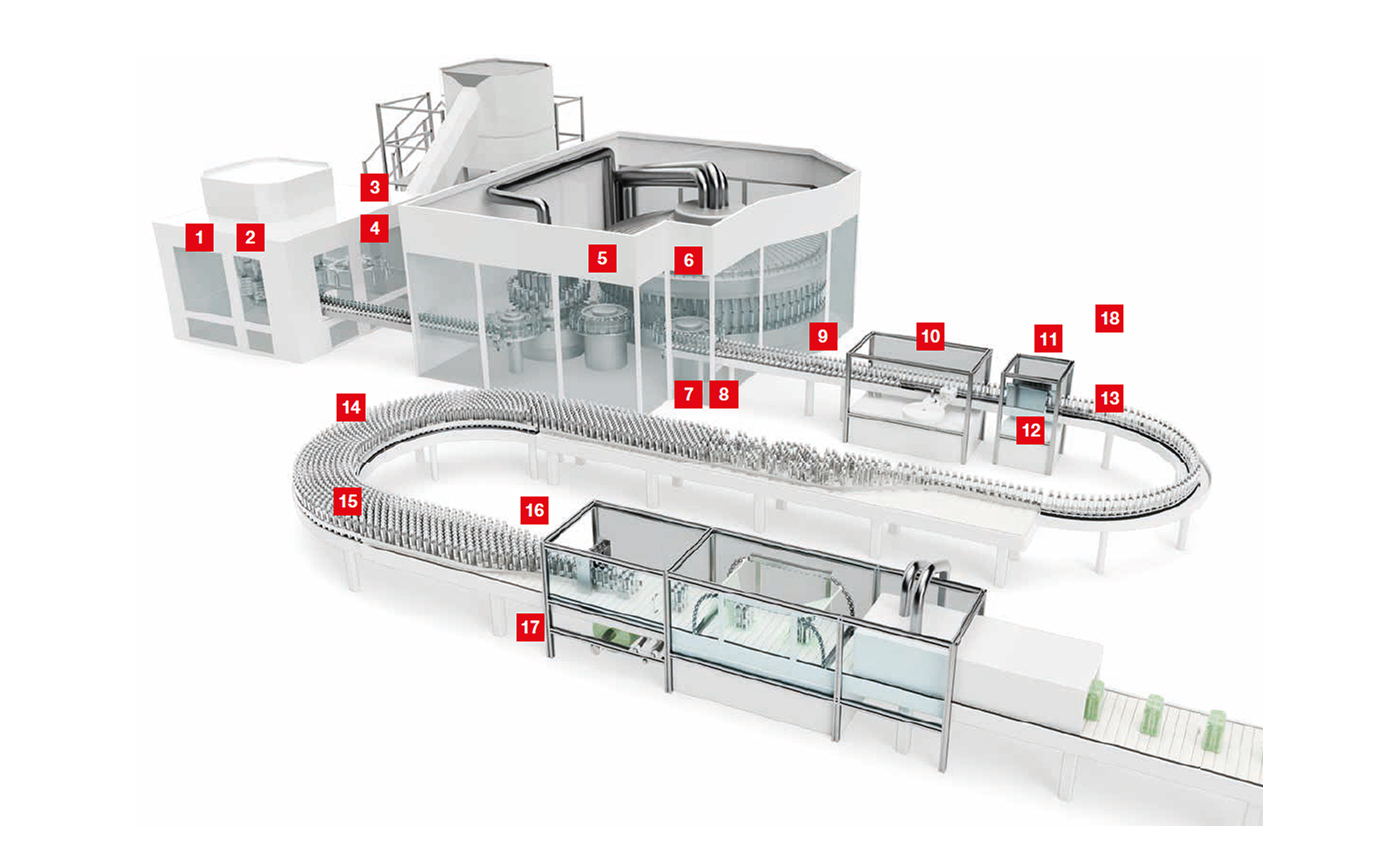
Our sensor solutions are used throughout the entire filling process – from the filling process through bottle transport and quality assurance to safety applications. The following diagram provides an overview of the individual process steps.
Click on the numbered applications to learn more about the respective sensor solutions.
Application areas in beverage filling
The entire filling process involves a wide variety of sensor applications, which can be categorized into the areas of filling, bottle transport, quality assurance, and safety.
Case studies from the beverage industry


Applications in beverage filling
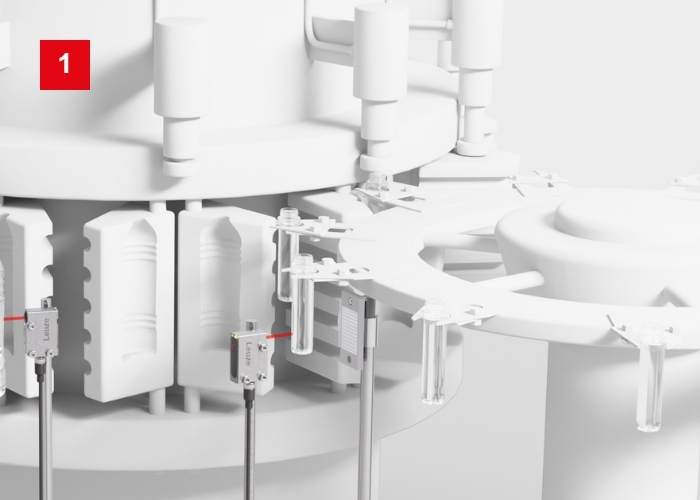
Detection of PET preform blanks
Requirement:
PET bottles are blown from preforms in filling systems for plastic bottles. For this purpose, the transparent preform must be detected on the feed to the stretch blow molding machine.
Solution:
The retro-reflective photoelectric sensors of the 25C, 55C and 18B series with autocollimation reliably detect transparent objects. They are ideally suited for detection tasks on stretch blow molding machines and compensate for temperature fluctuations and contamination.
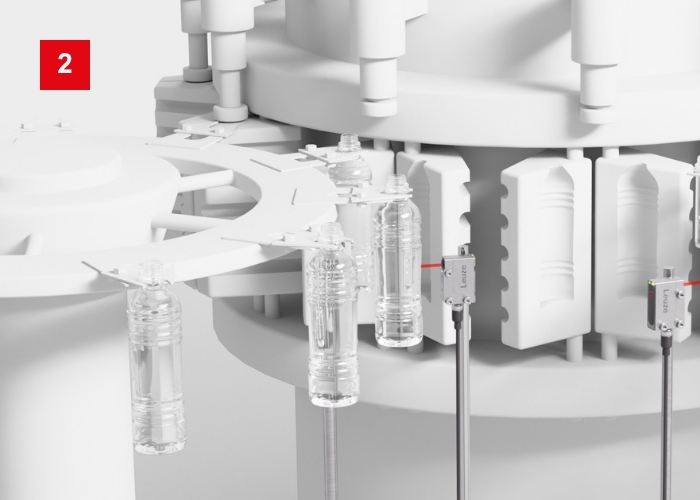
Detection of PET bottles
Requirement:
After the blank (preform) has been heated and blown into the mold, the now very thin and highly transparent PET bottle must be detected by the sensor with an extremely high level of reliability. This is the only way to ensure fault-free operation of the stretch blow molding machine.
Solution:
The 55C and 18B series retro-reflective photoelectric sensors with polarization filter are specially developed for the detection of highly transparent bottles. Temperature and contamination compensation offsets environmental influences. In this way, the sensors enable the machine to be operated over long periods without unplanned maintenance stoppages.
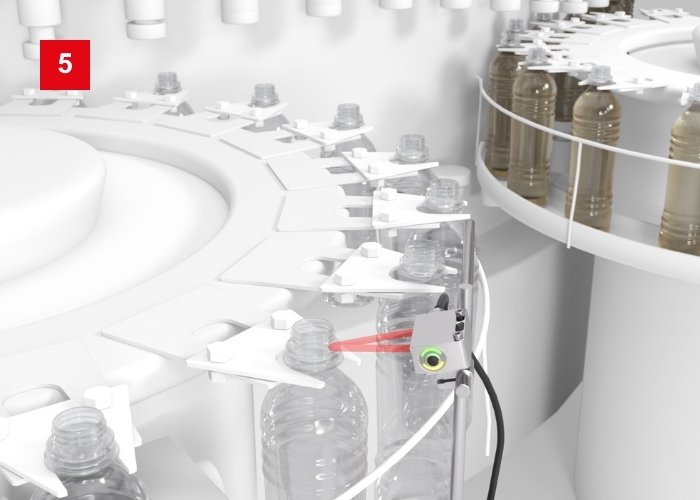
Bottle detection in transfer star
Requirement:
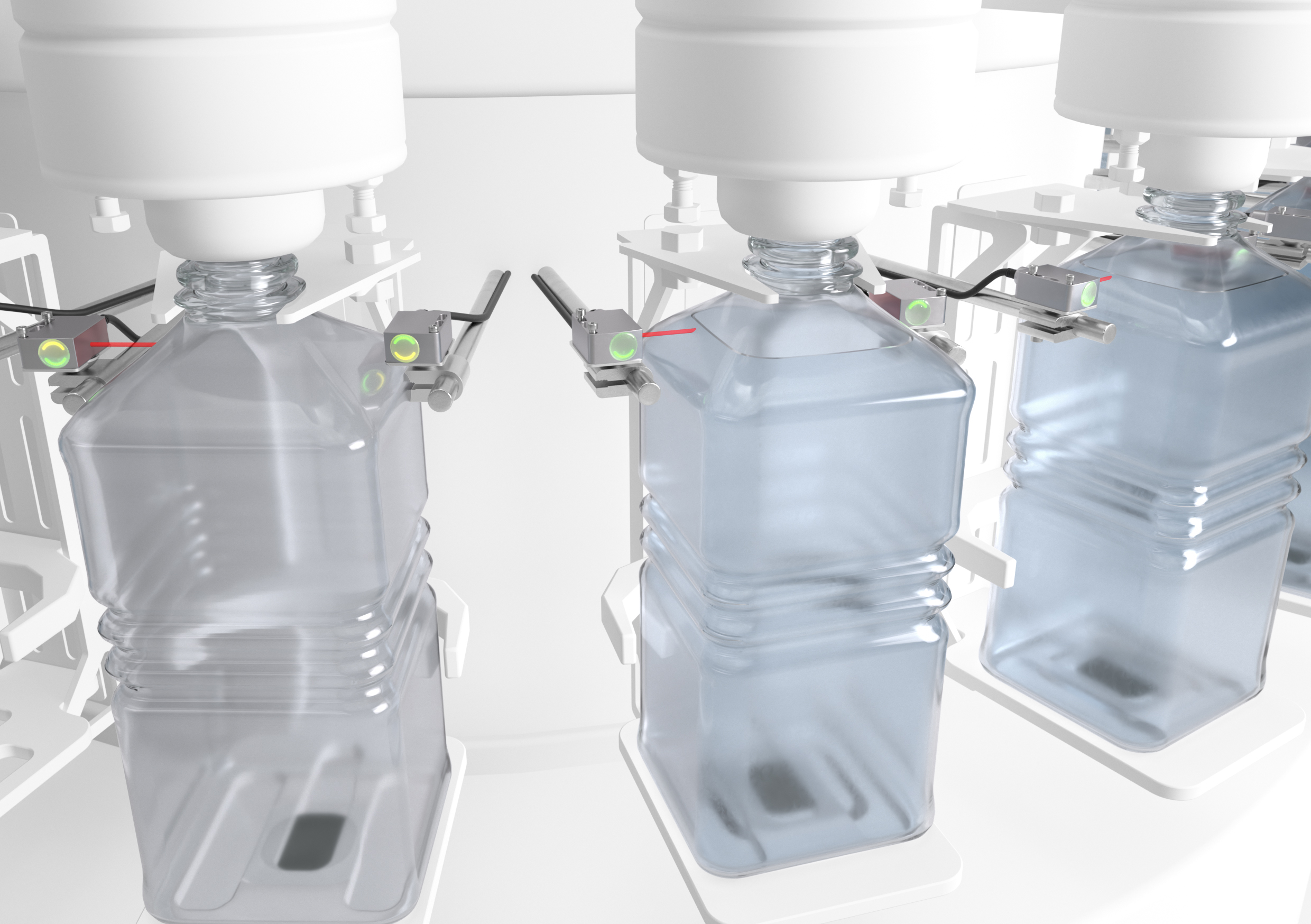
Bottle filling is characterized by very high speeds. To ensure a smooth process, it must be ensured before filling that all positions of the transfer star are occupied by bottles.
Solution:
The HT 55C.V diffuse sensor with background suppression reliably detects bottles during the filling process and does so without reflectors. ECOLAB certification and the enhanced Leuze cleaning agent long-term test CleanProof+ ensure the functionality of the sensor in wet areas and during intensive cleaning processes.
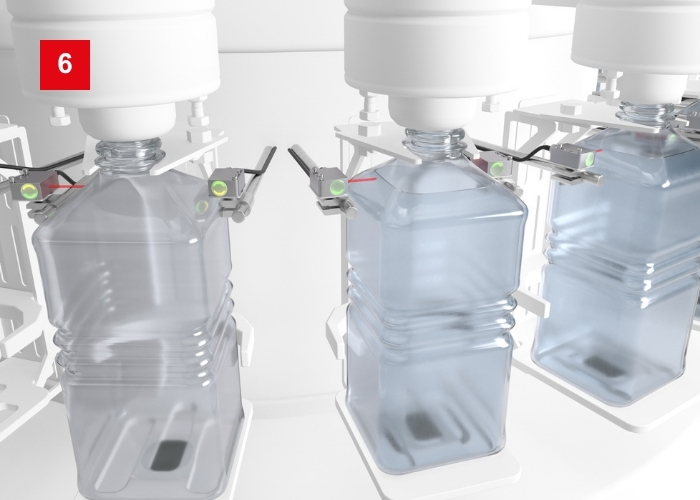
Fill level detection when filling
Requirement:
Water is filled into containers in a filling machine. The fill level must be exactly the same in all containers – underfilling should be prevented.
Solution:
The LS / LE55CI.H2O throughbeam photoelectric sensors are developed for the detection of aqueous liquids and for fill-level monitoring. The transmitter and receiver system of the stainless steel 55C series in wash-down design has a high radiation capacity and is also used with non-transparent containers and containers with plastic labels.
Applications in bottle transport
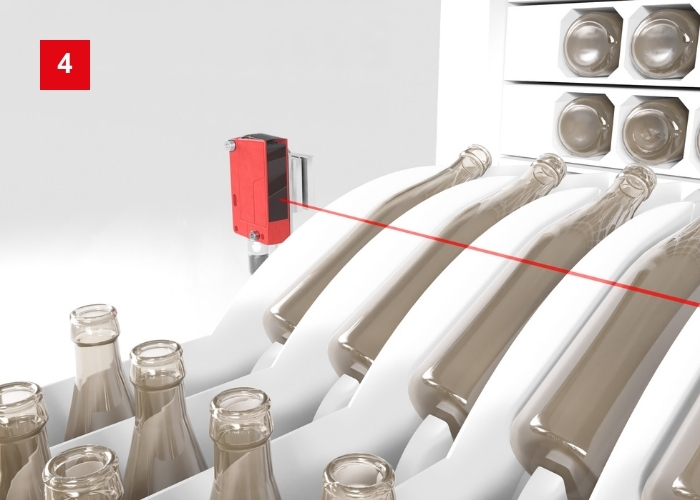
Overhang detection at the bottle washer
Requirement:
Reusable bottles are conveyed via mass transport to the bottle cleaning machine, where they are separated into aisles. They are then automatically inserted into the cleaning cells via a gripper system. Sensors are used to detect potential collisions or “bouncing” bottles.
Solution:
The 46C series reflective photoelectric sensors, in a plastic housing with protection class IP 69K, are designed with a high function reserve for this application. The special light spot shape reacts only to bottles, not to splashes, thus ensuring high availability.
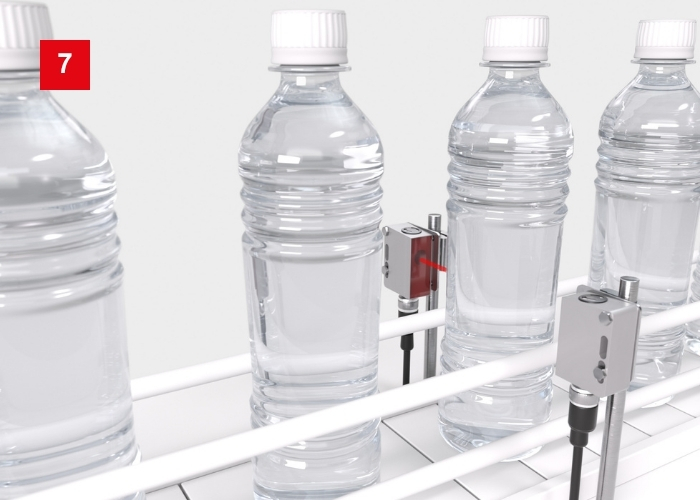
Distinguishing between filled bottles
Requirement:
After the filling process, empty bottles must be detected in order to recognize leaks in PET or glass bottles. This becomes particularly challenging when a clear liquid is in a non-transparent container.
Solution:
The LS / LE 55CI.H2O throughbeam photoelectric sensor is developed with an optimum wavelength for detecting aqueous liquids in transparent or opaque containers. During the filling process, the cleaning and environmental requirements are high, which is why the sensors are designed in stainless steel housings with protection class IP 69K.

Bottle detection during transport
Requirement:
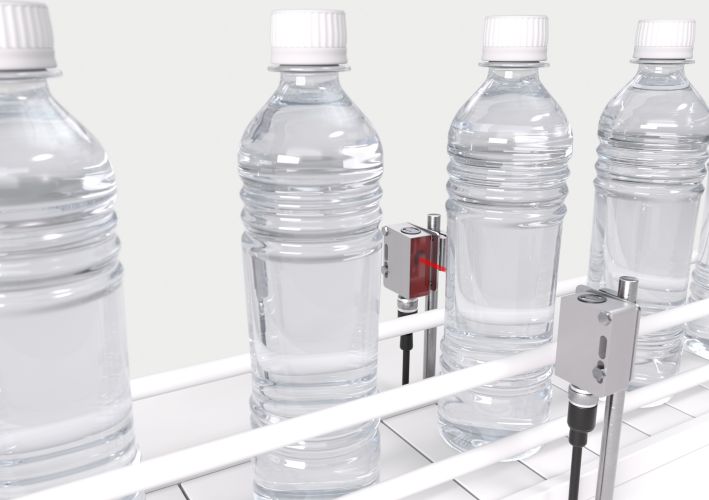
For the subsequent filling process, the bottles must be spaced apart to prevent them from colliding and thus causing noise pollution. In the transport line there are short conveyor sections where sensors detect the position of the transparent bottles.
Solution:
The 18B and 55C series retro-reflective photoelectric sensors feature a focused light spot and autocollimation (to detect small signal differences) for long-term fault-free operation.
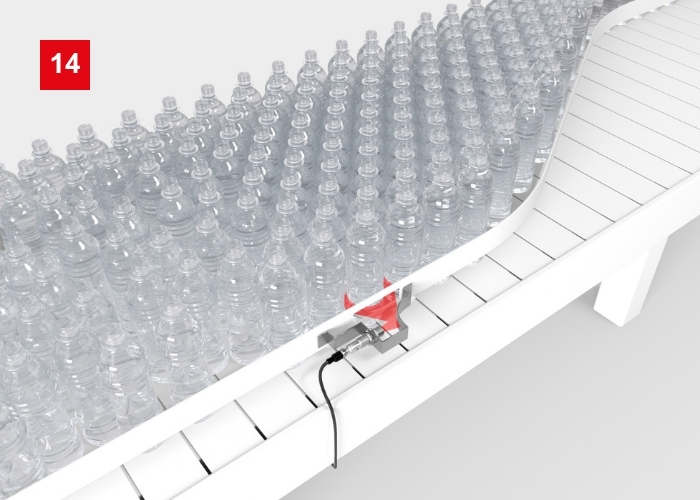
Fill level detection in mass flow
Requirement:
Containers are transported in mass flow on conveyor belts to the next station. For a continuous flow, the fill level must be monitored. To reliably detect different container sizes and shapes, a sensor with a large detection range is required.
Solution:
The robust and insensitive HTU 318 and HTU 418 ultrasonic sensors in metal or plastic housings with a large detection lobe and one or two switching points that can be set independently via IO-Link are ideally suited for changing container formats or colors.
Position detection in mass flow
Requirement:
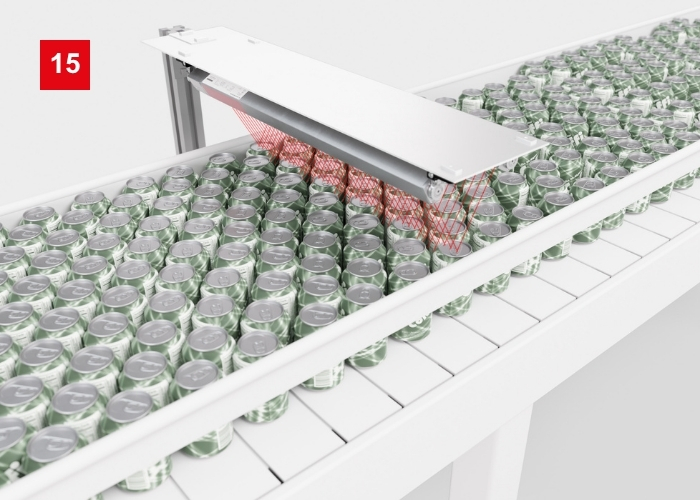
To detect disruptions in the mass flow, a uniform profile of the surfaces can be created from above. Gaps, for example caused by fallen cans, must be reliably detected.
Solution:
The CML 700 light curtain in V-configuration is developed for measuring moving objects that pass and detects interferences across the entire measurement width. As defects do not reflect light from the transmitter to the receiver, the sensor detects them immediately. Various interfaces are available.
Aisle control during package formation
Requirement:
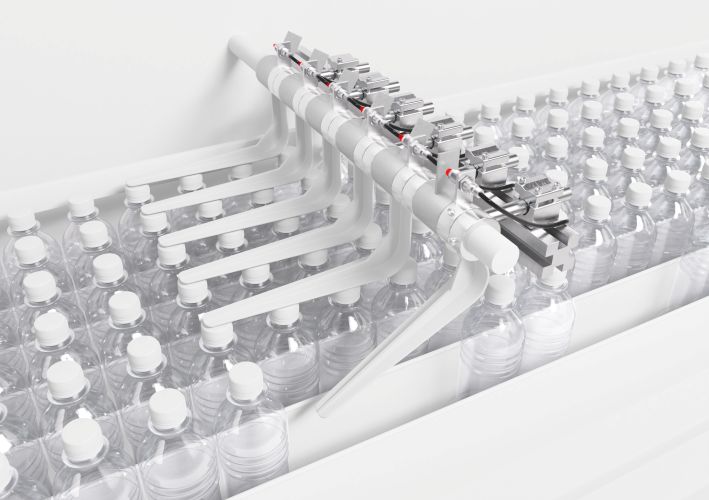
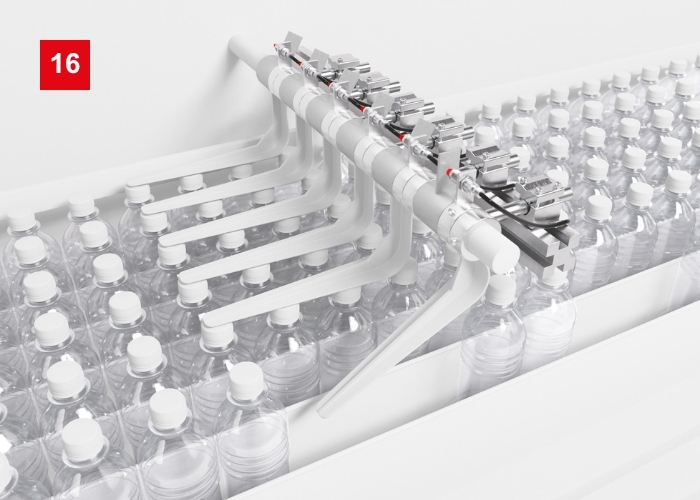
To ensure proper aisle control in the feed to the package formation area, gaps must be avoided. To this end, the containers are lined up in aisles and held back at appropriate points. Any gaps that occur must be detected and corrected via the conveyor control system.
Solution:
A simple solution is provided by mechanical brackets combined with sensors for end-position detection. The final position can be detected by an IS D18 or IS 218 inductive sensor in metal or stainless steel housings, via metal arms on the plastic brackets.
Position control in potentially explosive environments
Requirement:
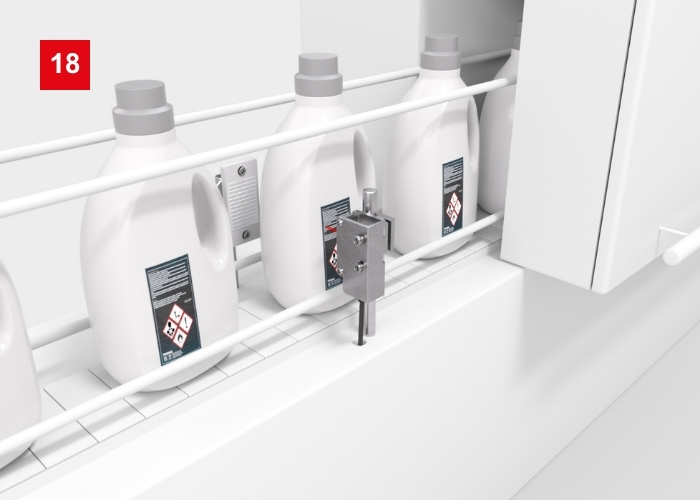
When filling potentially explosive materials, such as highly volatile substances or dusts, specially protected sensors must be used. Optical sensors need ATEX certification in hazardous areas.
Solution:
The 55 Ex series retro-reflective photoelectric sensor in combination with a reflector is a reliable solution for position detection in potentially explosive zones. 55 Ex series sensors are suitable for Ex-zone 2 (gas) or 22 (dust) environments.
Quality control applications
Presence control of bottle caps
Requirement:
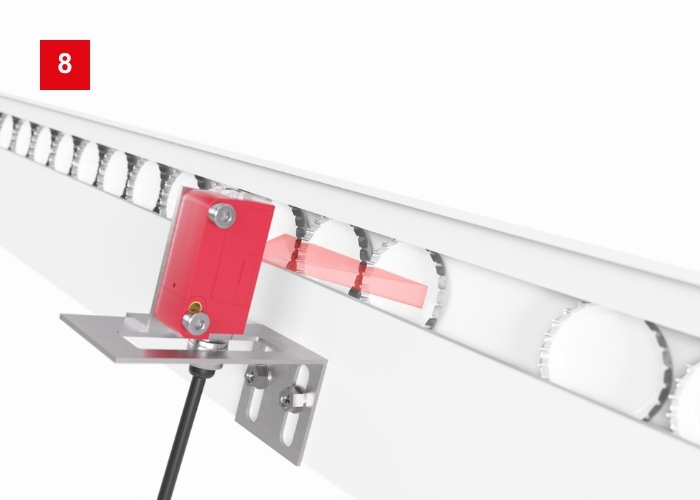
After the filling process, the bottles are automatically sealed with screw caps or crown caps. For a continuous production process, the presence of the bottle caps in the feeder must be checked. A reflector cannot always be attached here.
Solution:
Presence detection can be achieved using the 3C retro-reflective photoelectric sensors. If no reflector can be attached, an HT 3C.HL diffuse sensor with a long light spot is suitable for interrupted and irregular objects. For the detection of crown caps, an IS 200 series inductive sensor can be used alternatively.
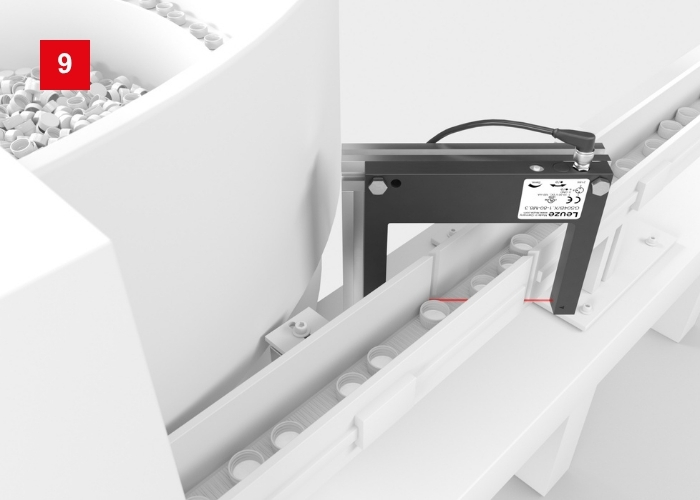
Cover feed
Requirement:
In filling and sealing machines, individual bottle caps in the cover feed must be reliably detected on their way to the capping machine.
Solution:
The GS 04B and GS 08B fork photoelectric sensors are ideal for detecting small parts. As the transmitter and receiver are located in one device, the compact solution can be integrated easily and without alignment work. The sensors are positioned horizontally to the feed, so each cap interrupts the light beam.
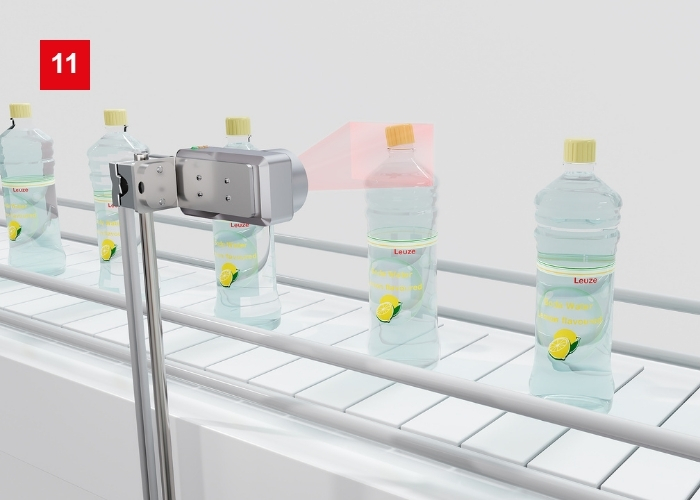
Bottle cap control
Requirement:
After the bottles have been sealed, the fit of the cap is checked at a test station. Only correctly fitted caps ensure a proper sealing of the bottle.
Solution:
With its extensive tool set, the IVS 1000i Simple Vision sensor can determine whether the bottle cap is sealed correctly. A user-friendly, graphical interface ensures fast setup and smooth operation of the sensor.
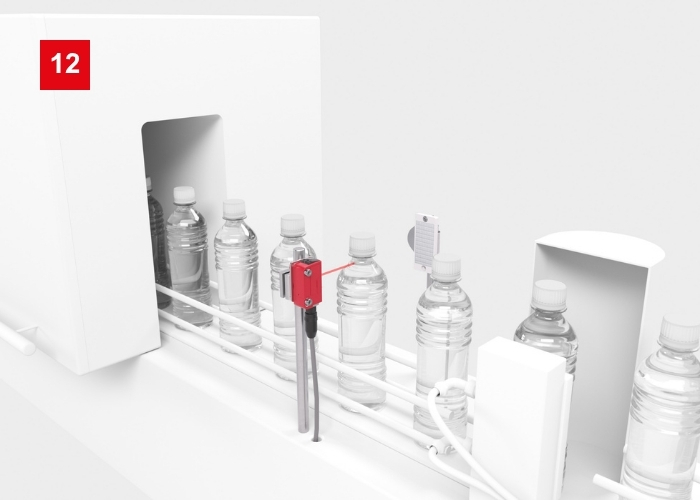
Detection of positions
Requirement:
In the fast processes of beverage filling, it is important to detect containers as precisely as possible. In inspection machines, the camera must be triggered with precise positioning. This requires sensors with short response times and focused, aligned light spots.
Solution:
Retro-reflective photoelectric sensors with laser light from the 3CL series in plastic housings or the 55CL and 18B series in metal housings enable precise triggering with a very small grid.
Applications in occupational safety
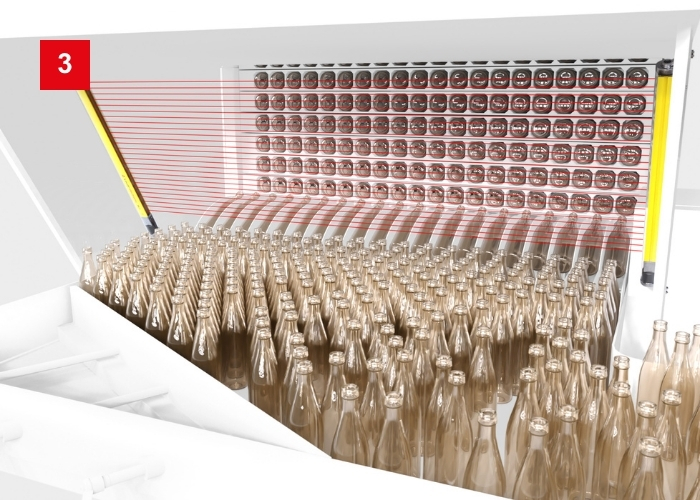
Guarding of points of operation during bottle cleaning
Requirement:
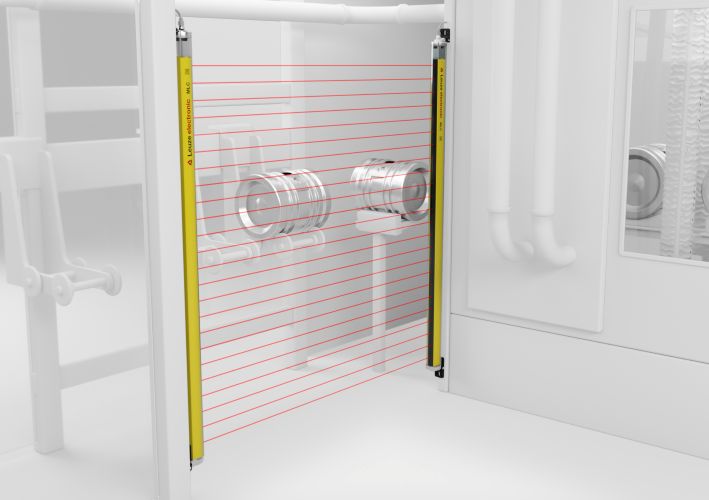
Machine openings ensure good accessibility to the system. The points of operation must be secured with optical protective devices during operation. This applies even in harsh environments, such as bottle cleaning machines.
Solution:
The MLC 500 safety light curtains are a flexible solution for guarding machine openings. They are available with a resolution from 14 mm and in protective field lengths up to 3,000 mm. For demanding environments, the models with protection class IP 69K in an encapsulated protection tube are suitable.
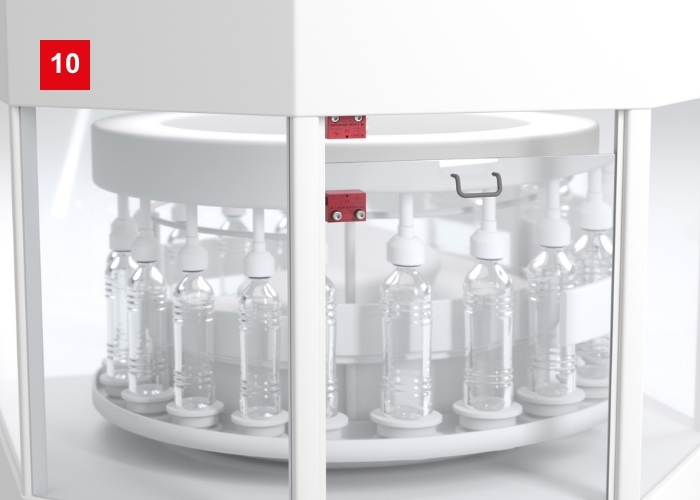
Monitoring of doors and flaps
Requirement:
Doors or flaps are often required on machines, for example to change consumables or to clean the machine. These must be closed during operation. To prevent hazards, the closing state must be monitored in terms of safety.
Solution:
The magnetically coded MC 300 safety proximity sensors monitor doors and flaps. Their enclosed design and contact-free function makes them ideal for use in harsh and damp environments. The devices are also easy to integrate thanks to their cubic and cylindrical designs.
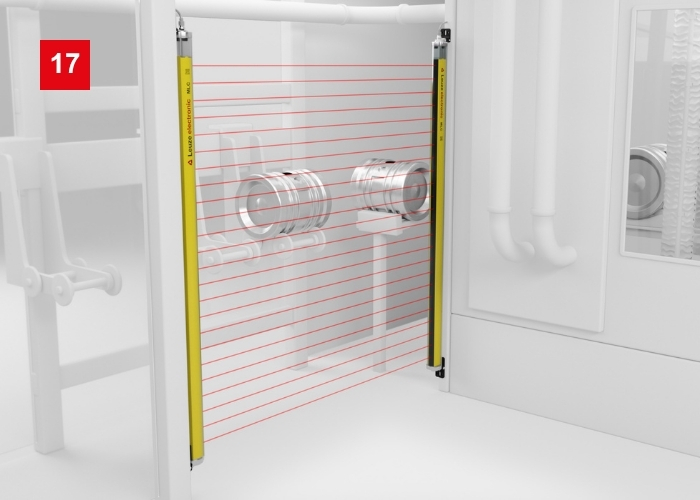
Safeguarding points of operation
Requirement:
In a cleaning system for barrels and kegs, there are access points for manual intervention. Safety sensors with a high IP protection class are required to safeguard the points of operation.
Solution:
The MLC 500-IP safety light curtains safeguard points of operation in hygiene-sensitive areas and have the highest protection class IP 69K. For this purpose, the light curtains are mounted in a transparent and encapsulated tube. Different resolutions and protective field lengths offer optimal adaptation to the application.
Special challenges in beverage filling
Beverage filling places the highest demands on the sensor technology used. A wide variety of container types must be reliably detected and processed: Soft packaging made of paper-film composites, semi-transparent and colored PET bottles, some of which are manufactured directly upstream of the filling line, as well as reusable bottles made of transparent or colored glass, barrels, and canisters. Reusable glass bottles and barrels, in particular, undergo additional cleaning processes to remove labels and residues before they are reused.
After cleaning, further process steps follow, such as sorting by size and format, as well as a visual inspection of the containers.
High conveyor speeds, vibrations, and fluctuating temperatures during production and cleaning must not affect detection reliability. At the same time, modern production concepts require rapid recipe and format changes. For this reason, sensor variants with IO-Link are increasingly being used, as they enable flexible parameterization, simple diagnostics, and quick changeovers.
Applications involving frequent cleaning processes and fluctuating temperatures require high resistance to cleaning agents and a robust, hygienic design. These sensor solutions meet the above requirements and are ideally suited for applications where both reliable detection and high durability are essential.
Detecting aqueous liquids in a wide variety of containers requires reliable detection even under demanding production and cleaning conditions. Special throughbeam photoelectric sensors enable reliable detection of aqueous liquids for this purpose. The compact stainless steel sensors meet the high protection class IP69K and have ECOLAB certification, enabling them to withstand even demanding cleaning and production conditions over the long term.